
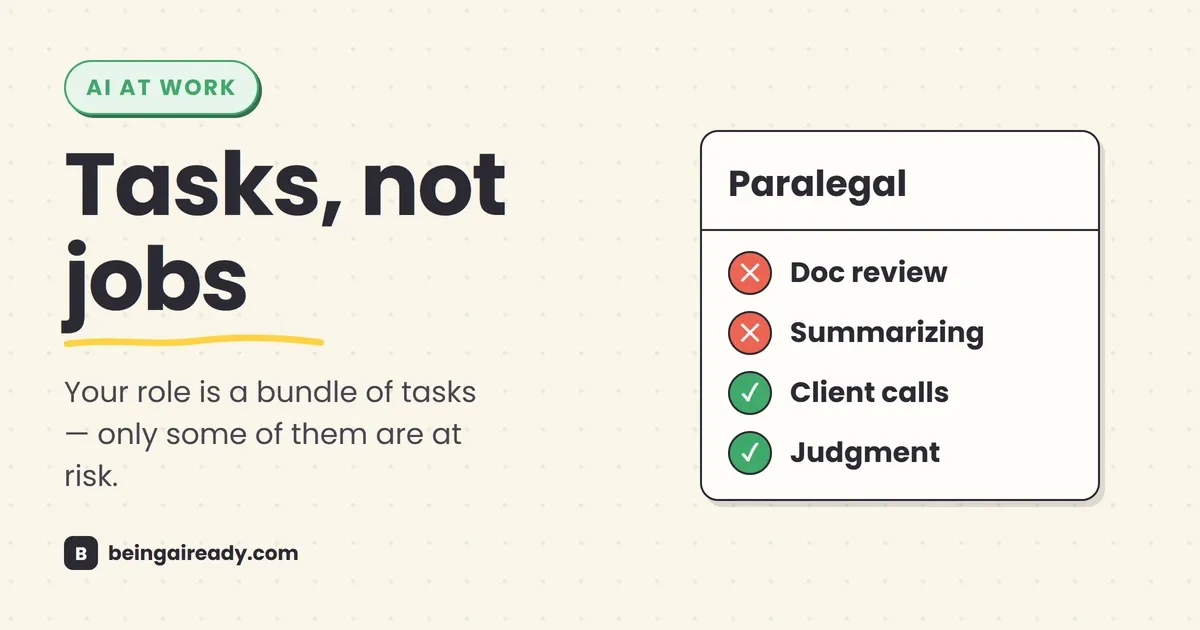
Will AI Take My Job? A Profession-by-Profession Guide
In 2013, two Oxford researchers published a paper estimating that 47% of US jobs were at “high risk” of computerization within a decade or two. It became one of the most cited numbers in the history of the future-of-work debate. A decade later, US unemployment was near a fifty-year low. The 47% did not happen, at least not as a wave of pink slips.
That is not a reason to relax. It is a reason to be more careful about the question. Predictions about technology and jobs have a long, humbling track record of being directionally interesting and specifically wrong, and “AI will take the jobs” is following the same script: broadly plausible, wildly overconfident about which jobs, and almost always silent on the part that actually matters, which parts of which jobs, and how fast.
This article is an attempt to answer the real question honestly. Not “is AI powerful” (it is) and not “will everything be fine” (that’s not guaranteed either), but the practical one you actually care about: given what you specifically do all day, what is likely to change, what isn’t, and what should you do about it? We’ll build a way of thinking that works for any job, look at what the big scary numbers really say, revisit what happened the last few times we automated something, and then go profession by profession. No hype, no doom. Just the shape of the thing.
Quick answer: AI is not, in the near term, going to take most whole jobs. It is going to take tasks, and every job is a bundle of tasks. The realistic outcome for most people is that AI automates the routine, high-volume, digital slices of your work, the job reshapes around the judgment, accountability, physical, and relationship parts that remain, and the people who learn to direct the tools do more than before. The jobs at genuine risk of disappearing are the ones made almost entirely of the tasks AI does well, with little judgment, physical presence, or accountability left over. Exposure is not the same as elimination, and the entry level is where the pressure lands first.
Here’s what you’ll walk away knowing:
- Why “will AI take my job?” is the wrong unit of analysis, and why “which of my tasks?” predicts your actual risk far better.
- What the headline numbers from Goldman Sachs, the World Economic Forum, McKinsey, and OpenAI’s own researchers really mean, and the crucial gap between “exposed” and “replaced.”
- What automation actually did to bank tellers and accountants, and why the counterintuitive answer is the most useful thing in this whole debate.
- The three things AI is genuinely bad at, accountability, the physical world, and real trust, that quietly protect most jobs.
- A profession-by-profession read on software, writing, support, law, medicine, teaching, design, trades, and more, with a verdict for each.
- The honest bad news: where AI is already biting, especially at the entry level, and what to do about it.
The question is slightly wrong: jobs are bundles of tasks
Start here, because everything else follows from it. A job is not a single thing that either survives or doesn’t. It’s a bundle of tasks, and automation acts on tasks, not job titles. This is the single most important idea in the entire debate, and it’s the one headlines are structurally incapable of expressing.
Think about what a paralegal actually does in a week: reviews documents, summarizes case law, drafts routine filings, manages deadlines and calendars, communicates with clients, files with courts, checks a partner’s work, and handles the small emergencies that don’t fit any category. Generative AI is genuinely good at three or four of those tasks and useless at the rest. The paralegal’s job doesn’t vanish; it rebalances, with less time on document review and summarizing, more on the judgment, coordination, and client-facing work that AI can’t touch.
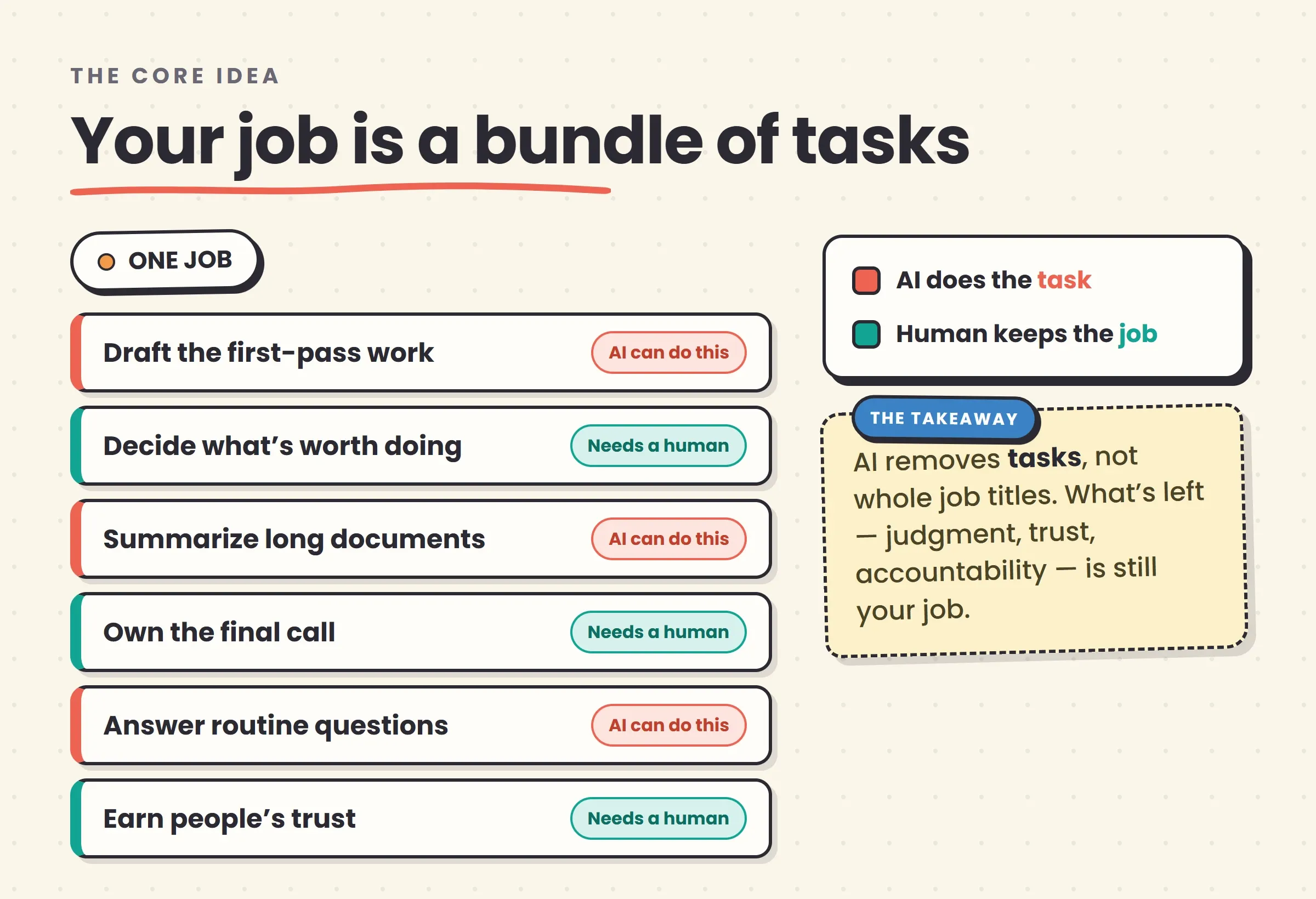
This is not a rhetorical trick to make AI sound harmless. It’s how the most serious researchers actually model it. When OpenAI’s own team studied the labor-market potential of large language models in the paper “GPTs are GPTs,” they didn’t score whole occupations as safe or doomed. They broke every occupation into its component tasks and asked how many of those tasks a language model could meaningfully speed up. Their finding is worth sitting with: around 80% of the US workforce could have at least 10% of their tasks affected, while only about 19% could see at least half their tasks affected. “Some of your tasks” is the near-universal case. “Most of your tasks” is the exception.
The economist David Autor at MIT has spent decades on the flip side of this, and it’s the part the doom framing always omits: automation doesn’t just subtract tasks, it creates new ones. His team’s analysis of eighty years of US census data found that more than 60% of the jobs people did in 2018 were in occupations that didn’t even exist in 1940. Nobody in 1940 was hiring for “search engine optimizer” or “user experience researcher.” The bundle of tasks that makes up the economy is constantly being repacked, and the new packing is very hard to see in advance. That’s not blind optimism; it’s the base rate.
So the useful question isn’t “will AI take my job?” It’s: what are the tasks that make up my job, which ones can AI do well, how much of my week do those tasks occupy, and what’s left when they’re gone? Hold that lens up to any role, including your own, and you’ll predict its future far better than any headline percentage. (If the word “AI” itself still feels slippery here, it’s worth being precise about what it means; our plain-English map of AI, machine learning, and generative AI untangles the terms.)
What the big scary numbers actually say
You’ve seen the numbers. Let’s put the four most-cited ones in a row, and then read the footnotes, because the footnotes are the whole story.
| Source | The headline number | What it actually measures |
|---|---|---|
| Goldman Sachs, 2023 | ”300 million jobs” exposed to automation | The equivalent of 300M full-time jobs’ worth of tasks, globally; most jobs “complemented rather than substituted” |
| World Economic Forum, 2025 | 92 million jobs displaced by 2030 | …alongside 170M created, for a net +78 million jobs |
| OpenAI / “GPTs are GPTs,” 2023 | 80% of workers affected | …affected on at least 10% of tasks; only ~19% on half their tasks |
| McKinsey, 2023 | 60–70% of work time automatable | Technical potential over decades, not a forecast of jobs lost |
Read the right-hand column and the picture changes completely. The Goldman Sachs figure that launched a thousand headlines, 300 million jobs “exposed,” sits in the same report as the sentence “most jobs and industries are only partially exposed to automation and are thus more likely to be complemented rather than substituted by AI.” The scary number and the reassuring caveat are in the same document. Only one of them made the news.
The word doing all the work here is exposure, and it does not mean what it sounds like. “Exposed” means “some of this task could in principle be done faster by AI.” It says nothing about whether it will be, whether the quality is acceptable, whether it’s legal or safe, whether anyone trusts it, or whether the human doing the rest of the job still needs to be there. A radiologist’s image-reading is highly “exposed.” Radiologists are, right now, in a historic shortage with salaries around $571,000. Exposure is a measure of technical overlap, not of destiny.
And the WEF number is the one to tape to your monitor: by 2030 they project 92 million jobs displaced and 170 million created, a net gain of 78 million, with churn touching 22% of all jobs. That “net positive but enormous churn” shape is the honest headline. It’s also cold comfort if you’re one of the 92 million and not one of the 170 million, which is exactly why the averages aren’t the end of the conversation, and why the rest of this article is about you, not the aggregate.
What automation did the last few times
We have run this experiment before. Not with AI, but with technologies that, in their moment, looked every bit as total. The results are consistent enough to be a genuine guide, as long as you draw the right lesson from them.
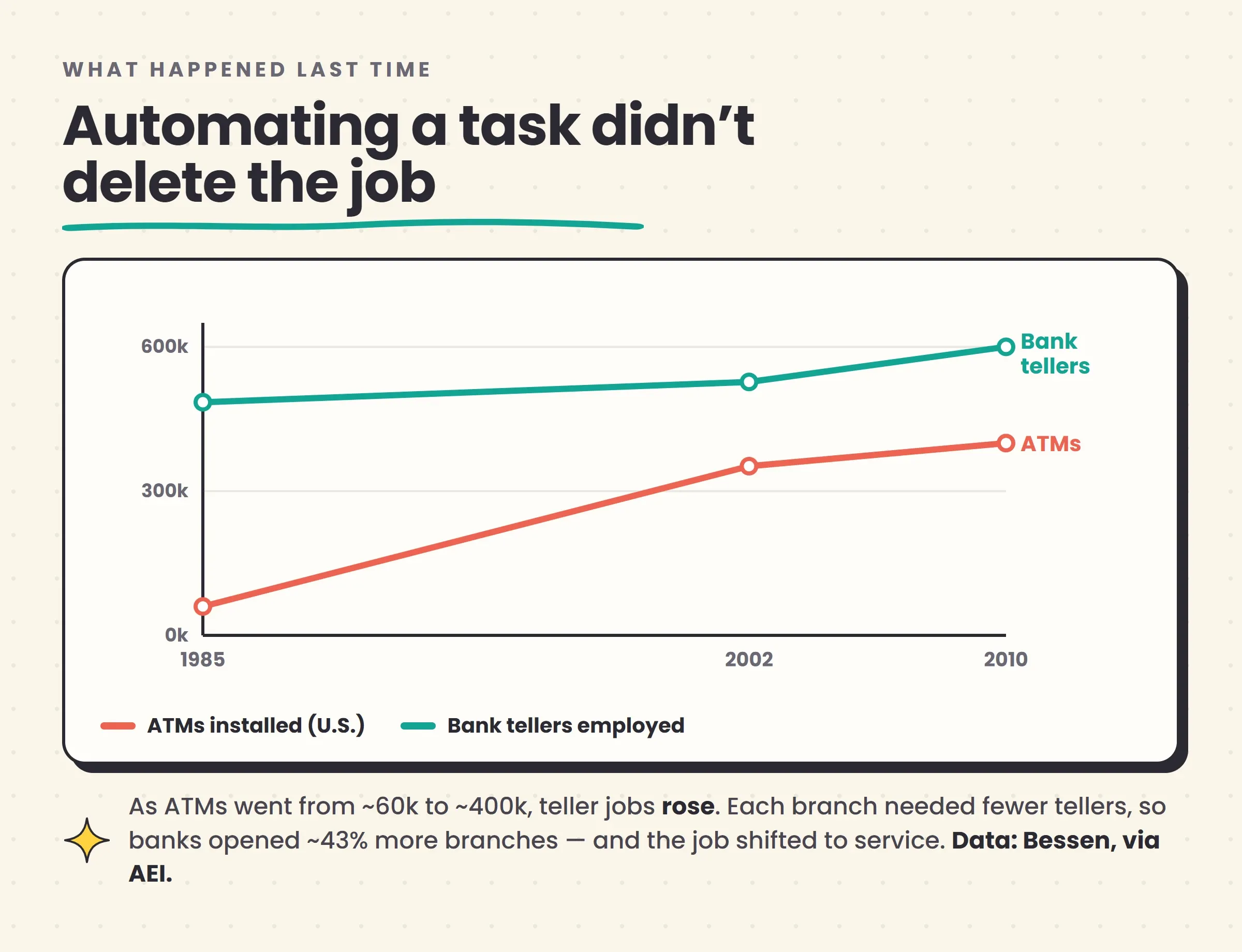
The cleanest case is the ATM. When automated teller machines rolled out across America, the obvious prediction was that bank tellers, whose literal job was dispensing cash, would be automated away. The opposite happened. Economist James Bessen documented that the number of bank tellers actually rose as ATMs spread: from roughly 485,000 in the mid-1980s toward 600,000 two decades later, even as ATMs went from a handful to hundreds of thousands. The mechanism is the interesting part. ATMs made running a branch cheaper, so banks opened far more branches (urban branches rose about 43%), and each branch needed fewer tellers but more of them overall. Meanwhile the teller’s job changed: less cash-counting, more sales, service, and relationships, the things ATMs couldn’t do.
The same thing happened with the spreadsheet, and the numbers are almost poetic. After VisiCalc and then Excel arrived, the routine number-crunching job, the bookkeeper, the accounting clerk, did shrink: the US lost roughly 400,000 bookkeeping and accounting-clerk jobs in the decades after 1980. But over the same period it added about 600,000 jobs for accountants and auditors. Making accounting cheaper meant people bought a lot more of it, more scenarios, more “what-ifs,” more analysis that was previously too expensive to bother with. The drudgery was automated; the judgment was amplified; the net was more jobs, but different ones.
Here’s the honest version of the lesson, because the cheerful version is misleading. The reassuring pattern is real: automating a task often expands demand for the whole activity, and shifts humans toward the parts machines can’t do. But notice who won and who lost inside each story. The clerk doing the routine slice shrank; the accountant doing judgment grew. The transition was not painless or automatic, it required people to move up the task ladder, and not everyone made the jump at the same speed. “It works out in aggregate” and “it works out for you, this year” are different claims. The history says the economy adapts. It does not promise the adaptation is comfortable, or that the new jobs go to the same people, in the same places, at the same time.
The three things AI is quietly bad at
If tasks are the unit, then the practical question becomes: which tasks resist automation, and why? Strip away the specifics and almost every durable job leans on at least one of three things today’s AI does genuinely badly. This is the analytical spine of the whole profession-by-profession read that follows.
1. Accountability and the cost of being wrong. A generative AI model produces the statistically plausible next word, not a verified truth, which is why it can state a confident, fluent falsehood in exactly the tone of a correct answer, a failure mode called hallucination. For a lot of tasks that’s a manageable nuisance. For anything where a wrong answer is expensive, a misdiagnosis, a bad contract, a structural miscalculation, a compliance breach, someone has to own the outcome, and “the AI said so” is not a defense a court, a regulator, or a patient will accept. The more a job is really about carrying liability and standing behind a decision, the more the human is load-bearing regardless of how good the draft was.
2. The physical world. There’s a famous observation in robotics, Moravec’s paradox, that the things humans find hard (chess, calculus, writing) are relatively easy for machines, while the things any four-year-old can do (walk across a cluttered room, fold a towel, fix a wobbly thing) are extraordinarily hard. An office is a controlled environment with clean digital inputs; a leaking pipe under a sink, a fault in a hundred-year-old fuse box, a frightened patient who needs turning, these are unstructured, variable, and full of one-off surprises. This is why economists consistently find skilled physical trades among the most resistant to automation, and why the number of truck drivers keeps rising despite a decade of self-driving hype.
3. Genuine trust and human presence. Some work is valuable precisely because a specific, accountable human is doing it. You can get therapy-shaped text from a chatbot, but the therapeutic relationship is the point. A teacher who notices a kid is off today, a nurse who holds a scared patient’s hand, a negotiator reading the room, a salesperson a client trusts with a big decision, the human presence isn’t a delivery mechanism for information that AI could deliver instead. It is the product. AI can support all of these people. It cannot be them.
Almost every “AI-proof” claim reduces to one of these three, and almost every genuinely exposed job is missing all three. That’s the real map. Now let’s use it.
The map: what actually protects a job
Plot any role on two axes and you can see its exposure at a glance. On one axis: how routine and digital are the core tasks, high-volume, repetitive, language-and-screen-based work sits on the exposed end; novel, physical, or high-stakes work sits on the resilient end. On the other: how much does the job depend on accountability, trust, and physical presence, the three things above.
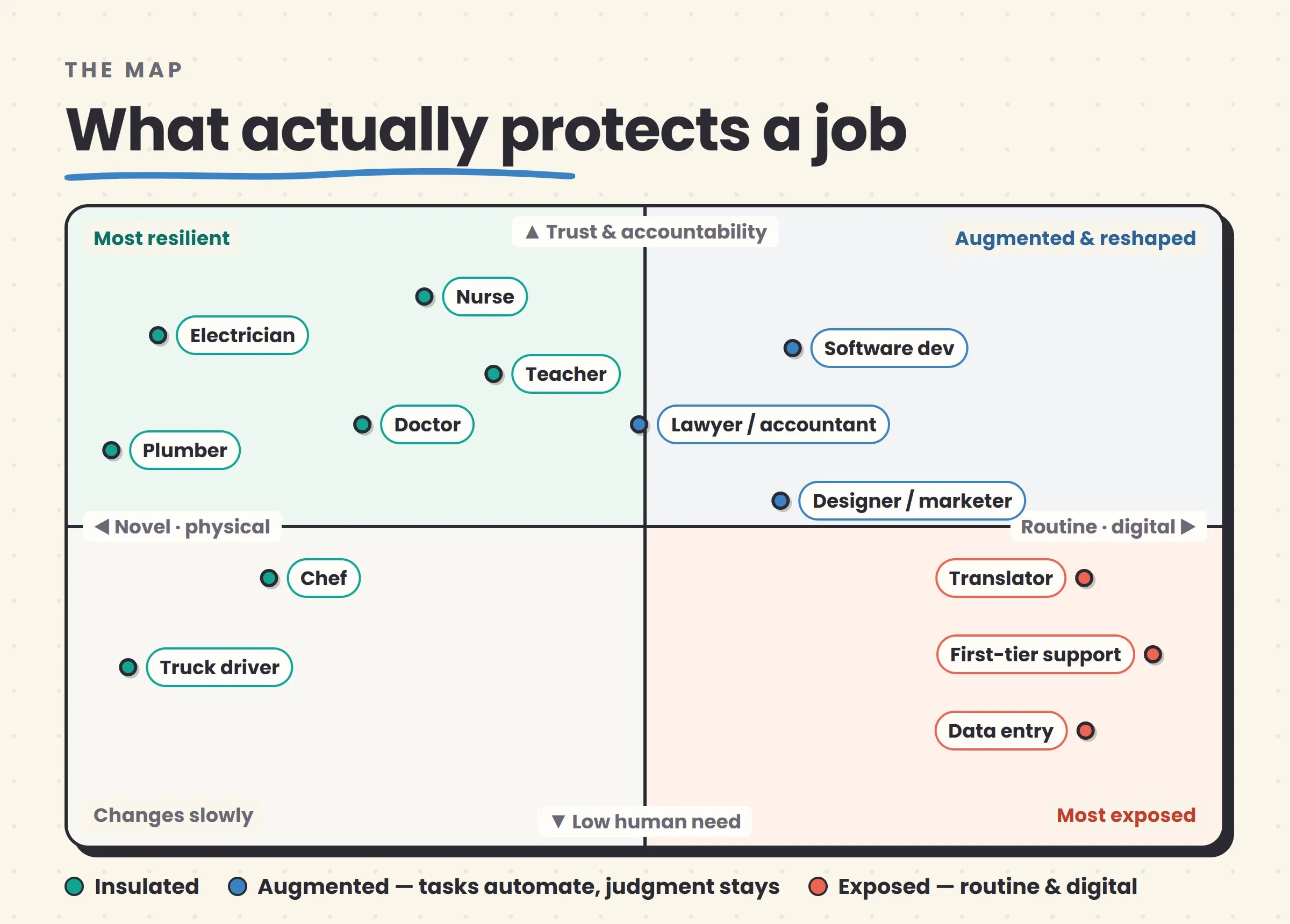
The exposed corner, routine, digital, low-accountability, is where you’d expect the first real displacement, and it’s exactly where the early evidence points. But before the profession list, one piece of genuinely bad news that the aggregate numbers hide.
AI is hitting the entry level first, and that’s a real problem. The tasks AI does best, first-draft writing, basic code, routine research, tier-one support, are disproportionately the tasks we’ve always handed to beginners. They’re how people learn a trade. Stanford economists analyzing payroll data found a 13% relative decline in employment for early-career workers aged 22 to 25 in the most AI-exposed jobs since late 2022, while employment for older workers in the same fields held steady. In software specifically, the number of very-junior developers has fallen sharply from its 2022 peak. This is the part of the “it’ll be fine” story that deserves real worry: if AI eats the bottom rung of the ladder, how does the next generation climb to the rungs that are safe? Nobody has a clean answer yet, and pretending otherwise would be exactly the kind of hype this article is trying to avoid.
Profession by profession
A summary first, then the detail. This table is a starting read, not a verdict on any individual, your specific role, seniority, and willingness to adapt matter more than the category.
| Profession | What AI already does well | What still needs a human | Near-term reality |
|---|---|---|---|
| Data entry / basic admin | Extraction, sorting, form-filling, routing | Exception-handling, judgment on messy cases | Most exposed; roles shrink and merge |
| First-tier customer support | Instant answers to common, simple queries | Complex disputes, empathy, accountability | High exposure; humans move to hard cases |
| Copywriters / content writers | First drafts, volume SEO copy, variations | Original voice, reporting, strategy, taste | Commodity end squeezed; senior end holds |
| Translators | Fast, cheap, good-enough routine translation | High-stakes, literary, live, cultural nuance | Volume falls; specialists and reviewers stay |
| Bookkeepers | Categorizing, reconciling, routine reports | Advisory, edge cases, audits, sign-off | Clerk work shrinks; advisory grows |
| Software developers | Boilerplate, tests, first-pass code, debugging | Architecture, judgment, ownership, systems | Augmented; juniors squeezed, seniors gain |
| Paralegals / junior lawyers | Doc review, summaries, research, drafts | Strategy, advocacy, accountability, clients | Tasks automate; the licensed judgment stays |
| Graphic designers | Mockups, variations, stock-style assets | Brand strategy, art direction, taste, clients | Production commoditizes; direction is prized |
| Marketers / analysts | Drafts, reporting, segmentation, A/B copy | Strategy, positioning, judgment, relationships | Augmented; output per person rises |
| Teachers | Lesson drafts, grading help, differentiation | Classroom presence, mentorship, motivation | Strongly insulated; AI is a tool, not a sub |
| Doctors / radiologists | Image triage, drafting notes, flagging | Diagnosis ownership, patients, the physical | Insulated; augmented, in shortage |
| Nurses / caregivers | Scheduling, documentation, monitoring | Hands-on care, presence, judgment | Highly insulated (physical + trust) |
| Skilled trades | Little, so far (some diagnostics, quoting) | Nearly everything (physical + novel) | Most insulated of all |
Knowledge and language work: augmented hard, automated in patches
This is the eye of the storm, because these jobs are made largely of the digital, language-based tasks AI does best.
Software developers are the clearest case of “augmented, not replaced,” so far. AI coding assistants like GitHub Copilot and Cursor genuinely speed up real work; GitHub’s controlled study found developers completing a task about 55% faster with Copilot. But writing code was never the whole job; deciding what to build, how systems fit together, what breaks at scale, and owning it when it does, remains stubbornly human. The catch is seniority: AI is best at exactly the boilerplate juniors cut their teeth on, and junior-developer hiring has been hit hardest. The job is safe; the on-ramp is narrowing.
Writers, copywriters, and journalists face a genuine split. AI writes a competent first draft of almost anything, and the floor of the market, high-volume, undifferentiated SEO filler, is being commoditized fast. What it can’t do is report (leave the building, talk to a source, verify a fact), and it can’t manufacture a distinctive voice or a point of view worth reading. The commodity-content writer is squeezed hard; the writer with reporting, expertise, or genuine style is arguably more valuable, because the median has been flooded and standing out is worth more. Tools like ChatGPT and Claude are best treated as a fast, unreliable intern whose work you must check, not a replacement for the judgment of what’s worth saying.
Customer support is where automation is furthest along, and Klarna is the cautionary tale worth knowing in full. In 2024 the company’s AI assistant handled two-thirds of its chats, doing the work of 700 agents. It looked like the future of the whole field. Then, in 2025, Klarna publicly walked it back and started rehiring humans, because on complex, emotional, or high-stakes cases the AI’s confident-but-wrong answers were a real cost, and customers wanted a human option. The settled shape isn’t “AI replaces support.” It’s “AI handles the easy 60–70%, humans handle the hard cases, and the human roles tilt toward the difficult and the accountable.” First-tier, script-following support shrinks; skilled support survives. (You can see the current tools mapped in our AI customer support directory.)
Paralegals, junior lawyers, accountants, and bookkeepers all follow the accountant-and-spreadsheet template almost exactly. Document review, contract summarizing, legal research, transaction categorizing, these are highly “exposed,” and Goldman put legal task-exposure around 44%. But the licensed, accountable core, giving advice a client relies on, signing off on an audit, standing up in court, is precisely the part where “the AI said so” is not an answer. The routine, high-volume slice compresses; the advisory and accountable slice grows in value. As with accounting in the 1980s, expect fewer clerks and more advisors, with a painful transition for anyone who was only doing the clerk part.
Translators are a real, if uneven, displacement. Machine translation via tools like DeepL is now good enough that the volume market for routine, good-enough translation has genuinely contracted. What survives, and commands a premium, is the high-stakes and the human: legal and medical translation where an error is catastrophic, literary work where voice is everything, live interpretation, and the cultural judgment no model reliably has. Many translators are shifting from translating from scratch toward post-editing machine output, a real job, but a different and often lower-paid one. This is one of the clearest cases where “the task got cheaper” genuinely shrank a market rather than expanding it.
Creative and strategic work: taste is the moat
Graphic designers, illustrators, and marketers live in an odd spot: AI can produce the artifact (a logo mockup, a stock-style image, a passable ad variation) but not the judgment (what should this brand feel like, which idea is actually good, does this fit the strategy). Production work, the churn of resizing, variations, quick mockups, is commoditizing. Art direction, brand strategy, and taste are, if anything, more valuable, because when everyone can generate a thousand mediocre options, the scarce skill is knowing which one is right. Image tools like Midjourney put a junior designer’s raw output in anyone’s hands; they don’t put a creative director’s judgment there. The people at risk are those who were selling production hours; the people gaining are those selling decisions.
People work: strongly insulated
Teachers, nurses, therapists, doctors, and caregivers are protected by two of the three moats at once, trust and (often) physical presence, and it shows. AI is a superb tool here: drafting lesson plans, differentiating materials, helping with documentation, triaging medical images. But the core of these jobs is a human being present with another human being, and that’s not a task you can hand to a model.
Medicine is the definitive case study, because we have a decade-old prediction to grade. In 2016 the AI pioneer Geoffrey Hinton said we should stop training radiologists because AI would outperform them within five years. It’s now a decade later, Hinton himself has acknowledged he was wrong on the timing, and radiology is in a shortage, with more than 4,000 open roles and average pay around $571,000. AI got genuinely good at reading images, one task, and radiologists absorbed it as a tool while imaging volumes grew faster than the tool could offset. The lesson isn’t “AI is useless in medicine.” It’s that a job with accountability, patient contact, and a hundred non-image tasks doesn’t collapse just because one of its tasks got automated.
Physical work: the most insulated of all
Electricians, plumbers, HVAC technicians, mechanics, chefs, construction workers, and truck drivers are, counterintuitively to anyone who assumed “blue-collar jobs go first,” among the least exposed to today’s AI. The reason is Moravec’s paradox: the digital, cognitive tasks are the easy ones for AI, and the messy physical world is the hard one. Diagnosing a fault in an unfamiliar building, working in a tight crawlspace, improvising when the part doesn’t fit, none of this is close to automatable, and the robotics gap is measured in decades, not quarters. The Bureau of Labor Statistics has consistently projected growth, not decline, for occupations people assumed automation would erase, including truck drivers, despite a decade of confident self-driving predictions. AI will help these workers, better diagnostics, faster quoting, smarter scheduling, before it comes close to replacing them.
The pattern underneath all of it
Step back from the professions and the same shape appears every time. The tasks that go first are routine, high-volume, digital, and low-stakes. The tasks that stay are novel, physical, high-trust, and accountable. Within almost every job, AI hollows out the middle of the routine work and leaves the two hardest ends, the truly simple stuff that turns out to need human judgment when it goes wrong, and the genuinely hard stuff that always did.
That has a clear implication for where value moves. It flows up the task ladder, from doing the routine work toward directing, checking, and owning it, and it flows toward the moats, toward the parts of your job that involve accountability, physical skill, or human trust. The uncomfortable corollary is that the people most exposed are the ones whose whole role sat on the bottom rung, and the ones best positioned are those already doing, or able to move toward, the judgment and relationship parts. This is also why the entry-level squeeze is the thing to watch: the ladder still exists, but the bottom rungs are being sawn off, and we haven’t yet rebuilt the way people climb.
None of this is destiny, and the timeline is genuinely uncertain. AI could plateau, in which case even the exposed jobs mostly just get augmented. Or capability could jump again, and some of the “safe for now” verdicts here will need revising, the honest ones always carry an asterisk. What won’t change is the method: watch the tasks, not the job titles, and you’ll see the shifts coming before the headlines do.
So what should you actually do?
Skip the panic and skip the denial. Here’s the pragmatic playbook, and it’s remarkably consistent across every profession above.
- Learn to direct the tools, not compete with them. The single most protective move in almost any job is to become the person who uses AI well, prompts it, checks it, and folds it into real work, rather than the person doing the task AI just learned to do. You don’t need to code. Our guide to prompting for non-technical people is a fifteen-minute head start, and doing it without getting into trouble at work matters just as much.
- Move up the task ladder deliberately. Identify the routine slices of your week that AI can already do, and spend the time you save on the judgment, relationship, and ownership work that it can’t. That’s not just defensive; it’s usually the more interesting part of the job anyway.
- Own the accountability. In any field where being wrong is expensive, position yourself as the person who verifies, decides, and stands behind the result. AI makes that role more valuable, not less, because it produces more output that needs a trustworthy human check. Knowing how to fact-check AI’s answers is fast becoming a core professional skill.
- Invest in the moats. If your work touches the physical world, human trust, or novel judgment, lean into it, that’s your durable advantage. If it doesn’t, deliberately build toward tasks that do.
- If you’re early-career, be strategic. The entry level is the squeezed rung, so make yourself more than a task-doer fast: get close to customers, take on judgment calls, and use AI to punch above your experience. And if you’re weighing a move into the field itself, breaking into an AI-adjacent career doesn’t require a technical degree, it requires being useful in ways AI isn’t.
The through-line is simple: you’re far less likely to be replaced by AI than to be outcompeted by someone using AI to do more than you. That’s a much more manageable problem, and it’s entirely within your control.
The bottom line
“Will AI take my job?” is the wrong question, and asking a better one is the whole skill. AI takes tasks, not jobs, and every job is a bundle of tasks, some of which will be automated, most of which won’t, and the mix determines everything. The honest forecast for most people is not unemployment; it’s a reshaped role, more AI-assisted, tilted toward judgment and trust, with fewer people needed for the routine slices and more value flowing to whoever directs and owns the work.
That’s genuinely reassuring for most jobs and genuinely not for some, and the two facts have to be held at once. The routine, digital, low-accountability corner of the economy is under real pressure, the entry level is being squeezed in a way that should worry all of us, and specific people in specific years will have a hard transition even as the aggregate stays positive, exactly as the ATM and the spreadsheet both created and destroyed jobs on the way to a net gain. Averages are not promises to individuals.
But the doom framing gets the mechanism wrong, and the mechanism is what you can act on. The bank teller wasn’t automated away; the job changed, and the tellers who leaned into the new parts did fine. The most useful thing you can do with the anxiety is convert it into a question you can actually answer: which of my tasks can AI do, which can’t it, and how do I spend more of my time on the second kind? Get good at that, and you stop being someone waiting to find out what AI does to your job, and start being someone deciding what AI does for it.
Frequently asked questions
Will AI take my job in the next five years?
For most people, no, not the whole job. AI is very good at automating specific tasks, drafting, summarizing, first-pass code, routine answers, but a job is a bundle of many tasks, and the ones involving judgment, accountability, physical work, and trust are much harder to automate. The realistic near-term outcome for most roles is that some tasks get automated, the job reshapes around what's left, and the people who direct the tools do more than before. Whole-job replacement is real but concentrated in narrow, routine, high-volume roles.
Which jobs are most at risk from AI?
The jobs most exposed are ones built mostly from routine, digital, language-heavy tasks with low accountability and low physical presence: basic data entry, first-tier customer support, entry-level copywriting, simple bookkeeping, and routine translation. Goldman Sachs estimated office and administrative support (about 46% of tasks exposed) and legal work (about 44%) sit high on the exposure list. Exposure is not the same as elimination, but these are where the pressure lands first and hardest.
Which jobs are safest from AI?
The most resilient jobs combine at least one thing AI is bad at: physical dexterity in unpredictable settings (electricians, plumbers, nurses, chefs), genuine human trust and accountability (therapists, senior doctors, teachers, negotiators), or novel judgment where being wrong is expensive. Skilled trades are especially insulated because the physical world is far harder to automate than office work, a pattern economists call Moravec's paradox. No job is fully immune, but these change slowly.
Is AI actually causing layoffs right now?
Partly, and it's growing, but the headlines overstate it. The outplacement firm Challenger, Gray & Christmas found AI was the stated reason for a small but rising share of announced job cuts through 2025 and into 2026. Separately, Stanford researchers found a 13% relative drop in employment for early-career workers (ages 22 to 25) in the most AI-exposed occupations since late 2022. The effect is real, concentrated at the entry level, and easy to confuse with ordinary economic cycles.
Should I learn to use AI to protect my career?
Yes, this is the single most practical move. In the near term, the people most exposed to displacement are usually those who compete with AI on the tasks it does well, while the people who direct AI, check its work, and own the outcome tend to become more valuable. Learning to use the main tools well, prompt them, verify their output, and integrate them into real work, is a low-cost, high-return skill in almost every profession, technical or not.
Hasn't every technology 'destroyed jobs' and been fine? Why is AI different?
The reassuring history is real: ATMs coincided with more bank tellers, spreadsheets with more accountants, because cheaper tasks often expand demand for the whole activity. But AI is genuinely broader than past tools, it targets cognitive and language tasks across almost every white-collar field at once, and it can hit entry-level rungs first, which is how people traditionally learned a trade. 'It'll be fine on average' can still mean a hard, uneven transition for specific people and specific years.
Related articles
What Can AI Agents Actually Do? 15 Real Examples by Use Case
See what AI agents can do today through 15 real examples across support, sales, research, finance, legal, HR, coding, IT, and security.
How to Use AI at Work Without Getting Into Trouble
AI at work isn't risky because it's AI — it's risky because most people never learn the six specific ways it backfires. Here's the practical rulebook.
Best No-Code AI Automation Tools in 2026: Zapier vs Make vs n8n
Zapier, Make, or n8n? A practical 2026 comparison of ease of use, AI features, integrations, pricing, control, and real-world fit.