
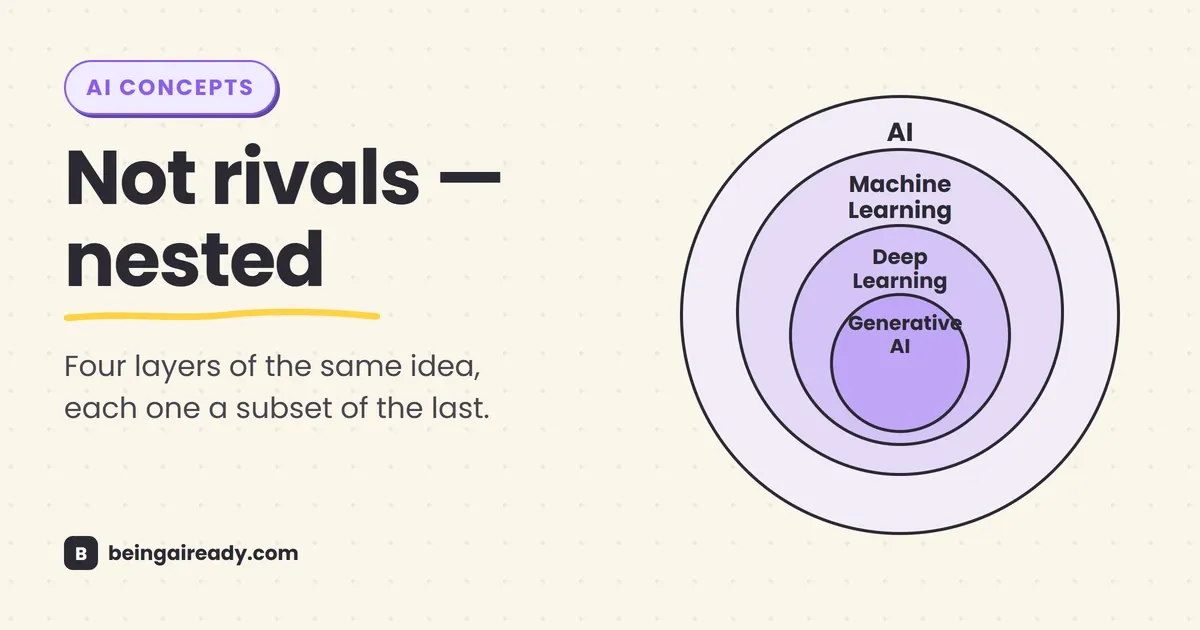
AI vs Machine Learning vs Deep Learning vs Generative AI
Sometime in 2023, recruiters started posting openings for “Generative AI Engineers, minimum 5 years’ experience.” Generative AI, as a category anyone outside a research lab could actually touch, was about a year old. Nobody was lying, exactly. They’d just watched three different terms, artificial intelligence, machine learning, and generative AI, collapse into one interchangeable buzzword so completely that a hiring manager could type a requirement like that and not notice anything strange about it.
That collapse isn’t only a hiring problem. Marketing decks do it. News headlines do it. Product pages that bolt a chatbot onto a spreadsheet tool call the whole thing “AI-powered,” and so does the company selling a genuinely novel piece of deep learning research. If you’ve ever felt a little lost about whether “AI” and “generative AI” mean the same thing, or whether machine learning is a newer idea than AI or an older one, you’re not missing some obvious piece of common knowledge. You’re reacting sensibly to four real, related, but distinct concepts that the industry has spent a decade using as if they were one word.
They’re not one word. They’re four layers, mostly nested inside each other like a set of Russian dolls, built in a specific order, decades apart, each one narrower and newer than the one before it. This article is the map: what each term actually means, how they fit together, how we ended up with four overlapping names for what often looks like one idea from the outside, and why bothering to keep them straight will make you noticeably harder to fool the next time someone hands you a pitch deck. (If a specific term still feels fuzzy after this, our plain-English AI glossary covers two dozen more, one at a time.)
Quick answer: Artificial intelligence is the broadest field: any technique that gets a machine to do something we’d call intelligent if a person did it, including old-fashioned hand-coded rules. Machine learning is a subset of AI where the system learns patterns from data instead of following rules a person wrote. Deep learning is a subset of machine learning that uses layered neural networks, and it’s the technique behind almost every recent AI breakthrough. Generative AI is the newest layer: systems, mostly but not exclusively built with deep learning, that create new text, images, audio, or code rather than just labeling or predicting something. Nested circles, not four separate technologies.
Here’s what you’ll walk away knowing:
- The four terms nest inside each other in a specific order, AI is the outer ring, then machine learning, then deep learning, with generative AI as the newest, most visible layer built mostly on top of deep learning.
- Each layer arrived decades apart, not all at once: 1956 for the term “artificial intelligence,” 1959 for “machine learning,” 2012 for the deep learning breakthrough that changed everything, and 2022 for generative AI’s mainstream arrival.
- Not all AI learns from data. Plenty of real, useful AI, a chess engine, a GPS route planner, an old-school expert system, runs on rules a person wrote, with no machine learning involved at all.
- Deep learning isn’t automatically the right tool. It wins on messy, huge datasets like photos and speech; it’s frequently overkill, more expensive, and harder to explain than simpler methods on small, structured data.
- Knowing which layer a product actually sits in is a practical skill, not trivia. It’s how you catch inflated marketing claims and ask sharper questions before you buy or build anything.
The map, in one paragraph
Picture four nested circles. The outermost, biggest circle is artificial intelligence: any technique, however simple or elaborate, that makes a machine do something we’d call intelligent if a human did it. Inside that sits machine learning, a specific approach to AI where the system finds patterns in data on its own instead of following rules a programmer typed out by hand. Inside machine learning sits deep learning, which uses neural networks stacked in many layers, and which is responsible for essentially every AI advance you’ve heard about since around 2012. And overlapping heavily with deep learning, mostly inside it but not universally defined that way, sits generative AI: systems built to produce new content, a paragraph, an image, a song, a block of code, rather than to sort things into categories or predict a number.
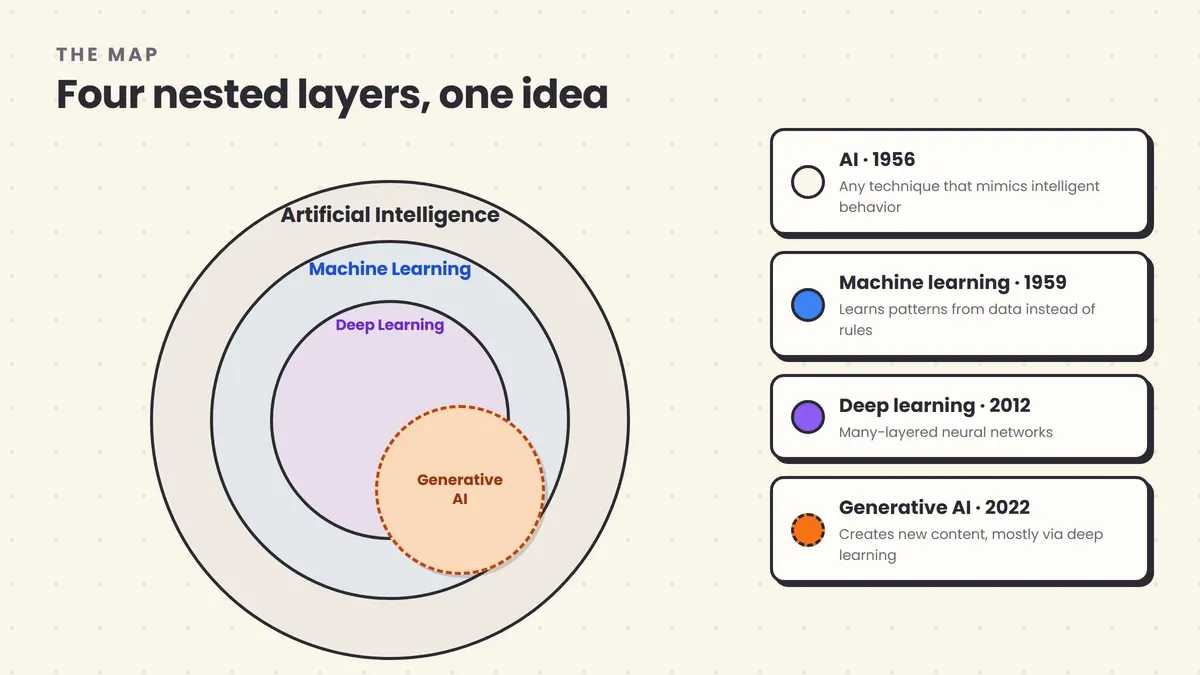
This nested framing is IBM’s standard explanation of the relationship and it echoes a well-known NVIDIA blog post that literally draws the four fields as concentric circles, with AI as the largest ring and deep learning nested innermost. Where sources genuinely disagree a little is generative AI’s exact position. IBM and NVIDIA both describe it as running on deep learning models, which puts it comfortably inside the DL circle for practical purposes. McKinsey’s explainer frames it slightly more loosely, as a capability shift within machine learning broadly rather than a strictly nested subset, closer to “the intersection of AI and natural language processing.” In practice, every mainstream generative AI system in use today, from ChatGPT to Midjourney to Stable Diffusion, is built on deep learning architectures: transformers, diffusion models, or generative adversarial networks. So the nested-circle picture is the right one to hold in your head, with an asterisk: the boundary between “deep learning” and “generative AI” is a boundary of purpose (classify or predict, versus create) sitting on top of largely shared machinery, not a boundary of entirely separate technology.
A brief history: four names, seven decades
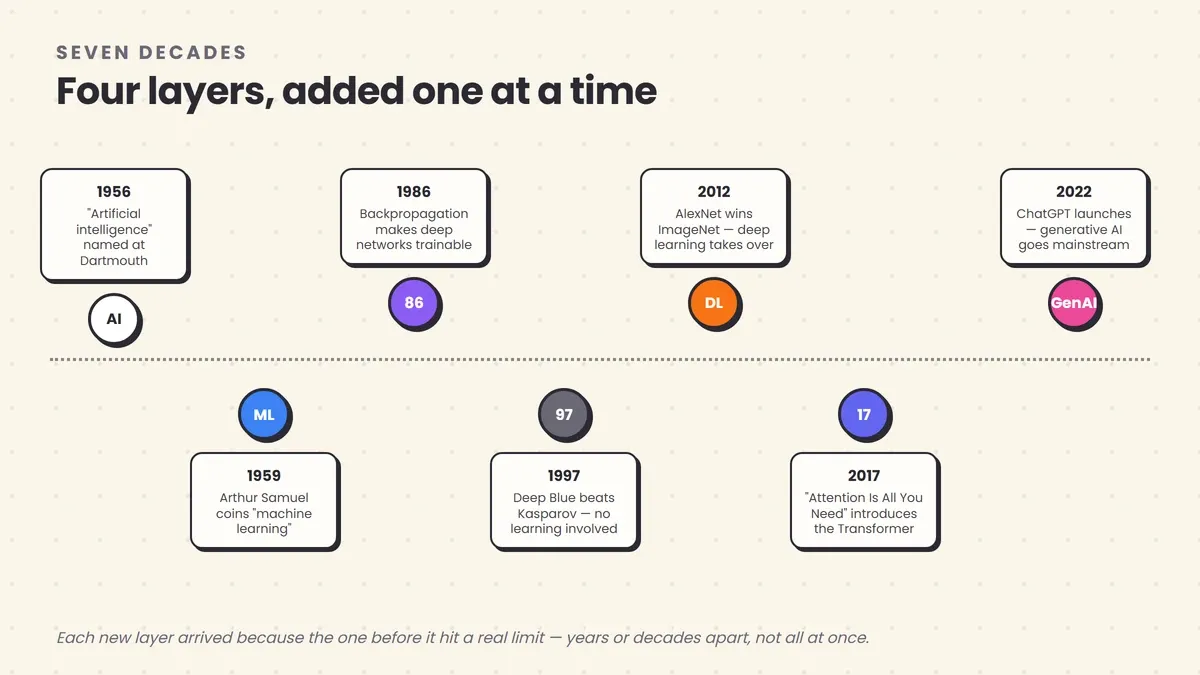
None of this arrived at once. The gap between the first term and the newest one is about 66 years, and each layer was added because the previous one hit a wall.
1950 to 1956: the field gets a name. In October 1950, Alan Turing published “Computing Machinery and Intelligence” in the philosophy journal Mind, proposing what became known as the Turing Test: if a machine’s conversation is indistinguishable from a human’s, does it matter what’s happening underneath? Six years later, in the summer of 1956, John McCarthy, Marvin Minsky, Nathaniel Rochester, and Claude Shannon convened a small workshop at Dartmouth College under a proposal that, for the first time in writing, used the phrase “artificial intelligence” to name the new field. That workshop is generally treated as AI’s founding moment, not because anything technical was invented there, but because the field finally had a name and a shared research agenda.
1958 to 1959: learning from data, and a name for that too. In 1958, Frank Rosenblatt built the Perceptron, an early neural network that could learn to classify simple patterns by adjusting its own internal weights, an ancestor of every neural network built since. A year later, IBM researcher Arthur Samuel published a paper on a self-improving checkers program and, in doing so, coined the term “machine learning”: software that gets better at a task through experience rather than through a programmer rewriting its rules.
Two winters. Progress from there wasn’t a straight line. AI hit a rough decade in the 1970s, driven partly by the UK’s 1973 Lighthill Report, which was sharply critical of the field’s progress, and partly by funding cuts that followed. A second, longer slump followed in the late 1980s and early 1990s, as expensive, brittle “expert systems” failed to scale and a boom in specialized Lisp hardware collapsed. Both periods are remembered as AI winters: stretches where funding and enthusiasm dried up because the technology couldn’t yet deliver on its promises.
1986: the technique that made deep networks trainable. Neural networks with many layers are hard to train, because it’s not obvious how to credit or blame any single internal connection for a wrong answer at the end. In 1986, David Rumelhart, Geoffrey Hinton, and Ronald Williams published “Learning Representations by Back-Propagating Errors” in Nature, popularizing backpropagation, the algorithm that efficiently spreads that blame backward through a network’s layers so each connection can be nudged in the right direction. It didn’t make deep learning practical immediately; the data and computing power to make it shine were still decades away. But it supplied the mathematical engine every deep network since has used to learn.
1997: a reminder that not all AI is learning. In May 1997, IBM’s Deep Blue defeated world chess champion Garry Kasparov in a six-game rematch, the first time a computer had beaten a reigning champion in a full match. It’s worth sitting with what Deep Blue actually was: a machine that searched hundreds of millions of possible move sequences per second using hand-tuned evaluation rules and custom chess-playing hardware, not a system that learned chess strategy from data. Deep Blue is a genuinely useful benchmark for this whole article, because it’s unambiguously artificial intelligence, and unambiguously not machine learning.
2012: the deep learning breakthrough. For decades, computer vision researchers hand-engineered the features a program should look for in an image, edges, corners, color gradients, because that was the only approach anyone knew how to make work. In 2012, Alex Krizhevsky, Ilya Sutskever, and Geoffrey Hinton entered a deep convolutional neural network called AlexNet into the ImageNet competition, and it beat every hand-engineered approach by a wide margin. That single result, combining Rosenblatt’s and Rumelhart’s decades-old ideas with modern GPUs and a much bigger dataset, is widely treated as the moment deep learning went from a promising academic niche to the dominant approach across nearly the entire field.
2014 to 2017: the machinery generative AI would later run on. In 2014, Ian Goodfellow and colleagues introduced generative adversarial networks (GANs), pitting two neural networks against each other, one generating fake images, one trying to catch the fakes, to produce startlingly realistic synthetic images. In June 2017, eight Google researchers published “Attention Is All You Need,” introducing the Transformer architecture, which is, without much exaggeration, the single idea underneath nearly every large language model in use today (we’ve covered how transformers and attention actually work in detail elsewhere).
2018 to 2022: generative AI leaves the lab. OpenAI released GPT-1 in June 2018 and GPT-3 in 2020, each a substantially larger transformer trained to predict text one piece at a time. Image generation followed the same path: DALL-E arrived in January 2021, and by August 2022 Stability AI had released Stable Diffusion as an open, publicly downloadable model. Then, on November 30, 2022, OpenAI released ChatGPT, a chat interface wrapped around a GPT model, and generative AI stopped being a research topic overnight: a UBS analyst note reported ChatGPT reached 100 million monthly active users by January 2023, roughly two months after launch, making it, by that measure, the fastest-growing consumer application on record.
2023 onward: the current wave. Since ChatGPT’s launch, the pace has been genuinely relentless: GPT-4 in March 2023, Anthropic’s first Claude models the same month and Claude 2 opening to the general public that July, Google’s Gemini in December 2023, and a steady annual cadence of larger, faster, cheaper models since, alongside a fast-growing focus on AI “agents” that can take multi-step actions rather than just answer questions. None of this changes the underlying map. It’s the same four layers, getting more capable and more visible.
Artificial intelligence: the outer ring
Artificial intelligence is the broadest of the four terms, and the oldest. IBM defines it as technology that enables machines to simulate human learning, comprehension, problem-solving, and decision-making. Crucially, that definition says nothing about how the machine does it. That’s the part most people miss: AI is defined by what a system accomplishes, not by any particular technique for accomplishing it.
That’s why Deep Blue counts as AI despite never learning anything from data, and why a GPS app calculating the fastest route counts too. Both use classical, symbolic AI: search algorithms and hand-written rules that a programmer designed in advance, sometimes called “good old-fashioned AI” in the research literature. A route-planning app, for example, is a textbook case of this older style: it searches a graph of roads for the path with the lowest total cost, weighing distance and traffic, using logic a person coded directly, no learning involved. So did MYCIN, a 1970s Stanford program that diagnosed bacterial infections using a hand-built library of if-then medical rules. Millions of dollars and person-hours went into systems built exactly this way for decades before “machine learning” became the dominant approach.
This is also why “AI” is such an unstable category to build a single opinion about. It spans a 1970s if-then medical program, a route planner doing pure graph search, and a modern language model, three systems built decades apart on completely different foundations, all correctly described as “artificial intelligence.” When someone says AI is overhyped, or that AI has been quietly running critical infrastructure for fifty years without anyone panicking about it, they’re both right, because they’re often talking about different points on that same 70-year-old spectrum.
Within AI, there’s also a distinction worth knowing between narrow AI and artificial general intelligence (AGI). Every AI system that exists today, including the most capable chatbots, is narrow: built and trained for a bounded set of tasks, however broad those tasks might feel in a conversation. AGI would match or exceed human ability across virtually any cognitive task, not just the ones it happened to be trained on. It’s worth being direct about this: AGI has no agreed-upon definition, and it remains entirely hypothetical. Nobody has built one, and reasonable, well-informed people disagree substantially, sometimes by decades, about whether or when one might exist. Treat any confident claim otherwise, in either direction, with real skepticism.
Machine learning: teaching by example instead of by rule
Machine learning is the first big departure from that rule-writing approach. Instead of a person hand-coding the logic, the system is shown examples and learns the underlying pattern itself, then applies that learned pattern to new, unseen data. Nobody sits down and writes a rule for “spam email looks like this.” Instead, a spam filter is shown thousands of emails already labeled spam or not-spam, and it works out statistically which words and patterns correlate with spam, using an approach like a Naive Bayes classifier, one of the earliest and most durable techniques applied to this exact problem.
There are three broad ways a machine learning system can be trained, and it’s worth knowing all three because they show up constantly in how AI products are described:
- Supervised learning trains on labeled data, examples where the correct answer is already known, and the model adjusts itself to minimize the gap between its prediction and that known answer. A credit-scoring model trained on years of past loans and their outcomes (repaid or defaulted) is a supervised learning system.
- Unsupervised learning trains on unlabeled data and looks for structure, clusters, or patterns without being told the right answer in advance. A retailer grouping customers into behavioral segments without predefining what those segments should be is a common example.
- Reinforcement learning has a system take actions in an environment and learn through trial and error, guided by rewards and penalties, rather than a labeled dataset at all. This is the technique behind systems that learn by playing a game against themselves millions of times.
Beyond spam filters and credit scoring, machine learning quietly runs a lot of the infrastructure you interact with daily: recommendation engines suggesting what to watch or buy next, fraud-detection systems scoring transactions in real time (PayPal, for instance, describes its fraud protection explicitly as machine learning scoring transactions against patterns learned from billions of prior ones), and pricing or demand-forecasting models used across retail and logistics. None of this needs deep learning specifically. Plenty of it runs on simpler, decades-old statistical methods, because those methods are often cheaper, faster, and easier to audit than a neural network, and just as accurate on smaller, well-structured datasets.
There’s a second thing that separates machine learning from the classical AI it grew out of, beyond just “learning versus rules”: where the intelligence in the system actually lives. In a hand-coded expert system, the intelligence is the programmer’s, translated into rules line by line. In a machine learning system, the intelligence is distributed across thousands or millions of learned numerical weights that no single person wrote or fully understands in detail, even though the training process that produced them is well understood. That shift, from a system you can read like a legal document to a system you can only really study by testing its behavior, is a big part of why machine learning products need a different kind of scrutiny than the rule-based software that came before them: you can’t just read the code to know what it will do with an input it hasn’t seen.
Deep learning: the 2012 turning point
Deep learning is a subset of machine learning defined by a specific structure: neural networks stacked in many layers, loosely inspired by, though far simpler than, how neurons connect in a biological brain. Each layer of a deep network transforms its input a little further, letting the network build up increasingly abstract representations, edges become shapes, shapes become object parts, object parts become recognizable objects, entirely from data, without anyone hand-specifying what an “edge” or a “shape” should look like.
That last point is what made 2012 the pivotal year. Before AlexNet, the standard approach to computer vision involved researchers manually engineering the features a program should search for. AlexNet, and the wave of research it triggered, showed that a sufficiently deep network fed enough data could learn better features on its own than people could design by hand. That single result reordered priorities across the entire field, and nearly every major AI advance since, from image recognition to speech recognition to language models, has been a deep learning system.
The training process itself follows a consistent loop: data flows through the network’s layers to produce a prediction, that prediction is compared against the correct answer, and backpropagation adjusts every connection’s weight slightly to reduce the error, repeated over enormous numbers of examples until the network’s predictions get reliably good.
That loop is also exactly why deep learning stayed a research curiosity for so long after backpropagation was published in 1986. Training a many-layered network well requires two things that simply weren’t available yet: a very large volume of labeled data, and enough raw computing power to run that training loop billions of times without it taking months. ImageNet, the dataset AlexNet was trained on, contained millions of hand-labeled images, and the graphics cards (GPUs) originally built for rendering video game frames turned out to be extremely well suited to the kind of parallel math a neural network needs. It took the internet generating enough data and gaming hardware becoming powerful and cheap enough, roughly a quarter century after backpropagation was first published, for the technique to actually work at scale.
That dependence on scale cuts both ways, and it’s the most practical thing to know about deep learning if you’re deciding whether to use it. It’s genuinely the best available tool for messy, high-dimensional data like images, audio, and free-form text, precisely because it can learn its own features instead of relying on a person to specify them. But it’s also expensive to train, data-hungry, and much harder to inspect after the fact than a simpler model, since the “logic” is spread across millions or billions of learned numbers rather than a readable rule.
You’ve almost certainly used several deep learning systems today without thinking about it. Apple has described Siri’s “Hey Siri” wake-word detection and speech recognition as running on deep neural networks, first a small network listening for the wake phrase, then a larger one converting sound into words. Photo apps that recognize faces or objects, and self-driving systems that need to identify pedestrians and vehicles from camera and sensor data, run on the same family of techniques: convolutional neural networks trained on millions of labeled images. And DeepMind’s AlphaGo, which beat a world-champion Go player in 2016 using deep neural networks combined with reinforcement learning and tree search, is one of the clearest public demonstrations of deep learning’s ceiling: Go has more possible positions than atoms in the observable universe, far too many to hand-code rules for, which is exactly the kind of problem deep learning was built to handle. We’ve written a full walkthrough of how the transformer architecture, deep learning’s most consequential recent variant, actually predicts text one token at a time, if you want the next level of detail.
Generative AI: the layer everyone’s actually talking about
Generative AI is what most people mean when they say “AI” today, and it’s the narrowest, newest layer of the four. IBM describes it as AI that creates original content, text, images, video, audio, or code, in response to a prompt, relying on deep learning models that learn the statistical structure of huge datasets well enough to produce new, plausible examples of that structure rather than simply sorting or scoring existing examples.
That “create versus classify” distinction is the whole point. A spam filter classifies: it takes an email and outputs a label, spam or not spam. A fraud model predicts: it takes a transaction and outputs a risk score. A generative model does something structurally different: it takes a prompt and outputs new content that didn’t exist before, built one small piece at a time from patterns learned during training. Under the hood, today’s generative systems mostly use one of three deep learning architectures: transformers, which power text tools like ChatGPT and Claude by predicting the next likely piece of text over and over (the full mechanism is worth reading if you haven’t; it’s genuinely not magic); diffusion models, which power most modern image generators including Stable Diffusion and DALL-E 2 by starting from random noise and learning to gradually remove that noise, guided by a text prompt, until a coherent image emerges; and GANs, the older adversarial approach from 2014 that still underlies some image and voice synthesis tools.
Generative AI’s reach now extends well past chatbots and image generators. GitHub Copilot generates code suggestions directly in a developer’s editor, built on large language models from OpenAI, Anthropic, and Google. Voice-cloning tools like ElevenLabs use neural networks to generate synthetic speech that mimics a specific voice, either from a short sample or from a more thoroughly fine-tuned model. Even here, precision matters: OpenAI’s original DALL-E didn’t use diffusion at all, it used a different transformer-based approach, and only DALL-E 2 and later moved to diffusion. Two products can share a brand name and sit on genuinely different underlying architectures, which is exactly the kind of detail that gets flattened when everything just gets called “AI.”
Generative AI also comes with a specific, structural limitation worth understanding rather than just being warned about: because these models are producing the statistically plausible next piece of content rather than retrieving a verified fact, they can generate a confident, fluent, completely fabricated answer with exactly the same tone as a correct one. That’s usually called hallucination, and it isn’t a rare bug, it’s a predictable consequence of how the technique works (we’ve gone deep on exactly why this happens elsewhere). It’s a genuinely different failure mode than what a classification model does when it’s wrong. A spam filter that misfires either lets junk through or blocks something legitimate, an error you can usually spot. A generative model that’s wrong writes it in the same voice as when it’s right, which is precisely why treating generative output as a first draft to verify, not a finished answer, matters as a practical habit rather than a theoretical caveat.
Putting the whole map together
| Layer | What it actually is | How it “learns” | A recognizable example | Took off around |
|---|---|---|---|---|
| Artificial intelligence | Any technique that makes a machine do something we’d call intelligent if a person did it | Often doesn’t learn at all — many AI systems follow hand-written rules or search through possibilities | A chess engine or GPS route planner | 1956 |
| Machine learning | A subset of AI where the system finds patterns in data instead of following hard-coded rules | Trained on labeled or unlabeled examples, adjusting itself to reduce prediction error | An email spam filter | Practical use from the 1990s–2000s |
| Deep learning | A subset of machine learning using many-layered neural networks | Same statistical learning as ML, with far more layers and far more data | A photo app recognizing faces | 2012 onward |
| Generative AI | A capability, mostly built on deep learning, that produces new content instead of a label or score | Learns the statistical structure of huge datasets well enough to generate new, plausible examples | ChatGPT drafting an email | 2022 onward |
Read down that table and the whole map compresses into one sentence: AI is the goal, machine learning is one strategy for reaching it, deep learning is one technique within that strategy, and generative AI is one thing you can build once you have that technique. Every layer after the first one exists because the layer before it hit a real limit; rule-writing didn’t scale to messy, ambiguous problems, hand-engineered features didn’t scale to raw pixels and audio, and prediction alone couldn’t produce a paragraph or a picture from scratch.
Where people actually get this wrong
A few mixups come up constantly enough that they’re worth naming directly, beyond what’s already covered above.
“It’s not real AI if it’s just machine learning.” This gets the hierarchy backward. Machine learning is AI; it’s simply a specific, and today dominant, approach to building it. The instinct that “real AI” must mean something more dramatic than pattern-matching on data is understandable, but it’s not how the field defines the term.
“Generative AI understands what it’s creating.” IBM Research is explicit that symbolic AI and today’s data-driven deep learning are two genuinely different paradigms, and generative models sit firmly in the second camp: statistical pattern generation, not symbolic reasoning about meaning. A model can write a technically fluent legal paragraph without anything resembling comprehension of the law behind it, which is exactly why checking generative output for accuracy matters so much.
“Deep learning is just a bigger, better version of machine learning.” Bigger and more data-hungry, yes. Automatically better, no. Deep learning tends to win on large, messy, unstructured data: images, audio, raw text. On small, clean, structured datasets, like a spreadsheet of a few thousand customer records, a simpler model is frequently just as accurate, trains in seconds instead of hours, and is far easier to explain to a regulator or a skeptical customer than a neural network with millions of internal parameters.
“AGI is coming in the next couple of years.” This deserves a direct, unhedged answer: nobody actually knows, and confident dates in either direction should raise your skepticism, not lower it. A 2023 survey of 2,778 AI researchers found a median estimate of 2040 to 2047 for human-level machine intelligence, depending on exactly how the question was framed, itself a sharp pull-forward from a 2060 median in the same survey series just one year earlier. That’s not a stable consensus you can round to a headline; it’s a wide, actively shifting range among the people closest to the research. Individual predictions from AI lab leaders swing even further in both directions, and those are opinions from people with a direct financial stake in the answer, not a neutral measurement.
“A newer AI model is always the better choice.” Newer usually means more capable on a benchmark, not automatically better for a specific job. A small, older, well-understood machine learning model that’s been quietly scoring transactions for a decade can still beat a brand-new general-purpose model on cost, latency, and predictability for that one narrow task. “State of the art” is a claim about a benchmark, not a guarantee that the newest tool is the right tool for what you’re actually trying to do.
A quick way to spot AI-washing
“AI-washing,” slapping the label on a product to sound more advanced than the technology underneath it actually is, is common enough that it’s worth having a short, practical checklist rather than relying on a marketing page’s word for it. Four questions tend to cut through most of it:
- What specifically learns, and from what data? If nobody can name a training dataset or a specific pattern the system learned, you may be looking at a rule-based automation wearing an AI label, which isn’t necessarily bad, but it’s a different product with different strengths than a trained model.
- What happens when it’s wrong? A well-built machine learning or deep learning product can usually describe its typical failure modes and how confident it is in a given answer. A vague “it just works” is a weaker signal than a specific, honest account of where the system struggles.
- Would a simpler tool do the job just as well? If the task is narrow and the data is small and structured, a basic statistical model or even a spreadsheet formula might match a flashy deep learning pitch at a fraction of the cost, and be far easier to explain later.
- Which of the four layers is actually doing the work? A product built around a general-purpose generative model, a custom-trained machine learning model, and a set of hard-coded business rules are three different things with three different risk profiles, even if the marketing page describes all three identically as “AI-powered.”
None of this is about being cynical toward AI generally. It’s the same due diligence you’d apply to any other technical claim before spending a budget or trusting an output, just aimed at a category of software that’s currently very good at sounding more uniform than it actually is.
Why bothering with this distinction actually matters
None of this is trivia for its own sake. Knowing which layer a product actually sits in changes how you evaluate it.
When a vendor says their tool is “AI-powered,” ask which layer they mean, because the answer changes what you should expect. A rule-based automation calling itself “AI” is not the same purchase as a genuinely trained machine learning model, and neither is the same as a product wrapped around a general-purpose generative model. Stanford’s 2025 AI Index reported that 78% of organizations used AI in some form in 2024, up from 55% the year before, and McKinsey’s 2025 survey found 72% specifically using generative AI, up from 33% just a year earlier. That’s an enormous amount of budget moving fast, on the strength of a label that, as this whole article has shown, gets used loosely. It’s also a big part of why we organize our own AI tool directory by the problem a tool solves rather than by a single vague “AI” label, since that label alone tells you almost nothing about what you’re actually buying.
This same fuzziness shows up in hiring, which is exactly where this article started. A job posting or a resume line that just says “AI experience” is nearly meaningless on its own; “built and deployed a supervised machine learning model” and “built product features on top of a general-purpose generative model” describe genuinely different skill sets, even though both would honestly be described as “AI work.” If you’re navigating that distinction from the job-seeking side, we’ve written a full guide on breaking into an AI career without a technical degree that goes deeper on exactly which of these layers different AI job titles actually touch.
It also sharpens how you read the news. A story about a breakthrough in protein-folding prediction is almost certainly a deep learning story, not a generative AI one, and a story about a chatbot hallucinating a fake citation is a generative AI story with a specific, well-understood cause, not evidence that “AI in general” is untrustworthy. Collapsing four layers into one word makes every story sound like it’s about the same thing, when they’re often about genuinely different technologies with different strengths, different failure modes, and different levels of maturity.
And it matters for anyone actually building or buying something. If your problem is a few thousand rows of structured customer data, reaching straight for a large generative model is usually solving the wrong problem with the newest available hammer; a simpler machine learning model will likely be cheaper, faster, and more explainable. If your problem genuinely involves generating fluent, novel content at scale, that’s exactly the layer generative AI was built for. Knowing the map means you can match the tool to the actual job instead of the loudest current buzzword.
A one-paragraph mental model to keep
If you keep nothing else from this article, keep this: artificial intelligence is the goal (make a machine do something we’d call intelligent), machine learning is a strategy for reaching that goal (learn patterns from data instead of hand-coding rules), deep learning is a specific technique within that strategy (stack neural network layers to learn increasingly abstract patterns on your own, without hand-engineering the features), and generative AI is a specific thing you can build once you have that technique (produce new content instead of just a label or a score). Each layer is narrower than the one before it, each one arrived years or decades after the last, and each one exists because the previous layer hit a real, specific limit that the next one was built to solve.
The bottom line
Four terms, seventy years, one nested structure: AI is the field, machine learning is how most of modern AI actually works, deep learning is the specific machine learning technique behind nearly every recent breakthrough, and generative AI is the newest, most visible thing you can build with that technique. None of them are interchangeable, and the differences aren’t academic pedantry, they’re the difference between a hand-coded chess engine from 1997 and a language model writing a paragraph in 2026, two things that get called “AI” in exactly the same breath despite having almost nothing in common under the hood.
You don’t need a computer science degree to hold this map. You need the nested circles, the rough timeline, and the habit of asking one simple question the next time a product, a headline, or a job posting throws the word “AI” at you: which layer, specifically, are we actually talking about? That question alone puts you ahead of most of the market.
Frequently asked questions
Is ChatGPT the same thing as AI?
No. AI is the entire, decades-old field of building systems that perform tasks normally requiring human intelligence. ChatGPT is one specific product: an interface built around a GPT-family large language model, itself a deep learning system trained on text. AI is the whole category; ChatGPT is a single, narrow application living several layers down inside it.
Is all AI machine learning?
No, and this is one of the most common mixups. Classic 'symbolic' AI, like a chess engine searching millions of possible moves or an expert system built from hand-written if-then rules, is genuine AI that never learns from data at all. Machine learning is a specific, newer approach to AI, where the system learns patterns from examples instead of following hand-coded rules.
Is generative AI the same as deep learning?
Not quite, though they're closely related. Deep learning is the underlying technique: layered neural networks trained on data. Generative AI is a capability built mostly, though not universally, on top of deep learning: the ability to produce new text, images, audio, or code, rather than just classify something or predict a single number.
What's the difference between narrow AI and AGI?
Every AI system in use today, including the most capable chatbots, is 'narrow' AI, built and trained for a bounded set of tasks. Artificial general intelligence (AGI) would match or exceed human ability across virtually any cognitive task, not just the ones it was trained on. AGI remains hypothetical, and experts genuinely disagree, sometimes by decades, on whether or when it might arrive.
When will AGI actually arrive?
Nobody knows, and you should treat any confident date with suspicion. A 2023 survey of 2,778 AI researchers put the median estimate for human-level machine intelligence somewhere between 2040 and 2047 depending on how the question was worded, down sharply from a 2060 median in the same survey series just a year earlier. Predictions from individual AI lab leaders vary even more and are opinions, not consensus.
Is deep learning always better than older machine learning methods?
No. Deep learning tends to win when there's a huge amount of data and a genuinely complex pattern to learn, like recognizing objects in photos. For smaller, structured datasets, like predicting customer churn from a spreadsheet, simpler machine learning methods are often just as accurate, far cheaper to run, and much easier to explain to a regulator or a customer.
Related articles
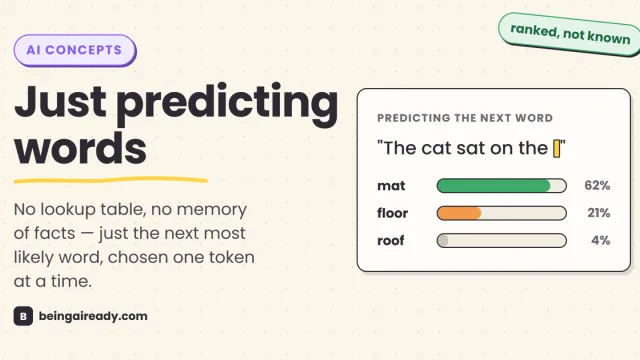
How Large Language Models Actually Work (Without the Math)
Large language models don't know facts, they predict the next likely word. Here's what's actually happening inside ChatGPT and Claude, no math required.
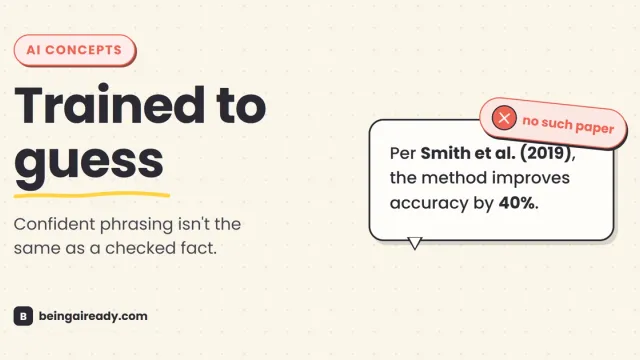
AI Hallucinations: Why AI Confidently Makes Things Up
AI hallucinations aren't random glitches. New research shows they're a predictable result of how models are trained and scored, and how to catch one.
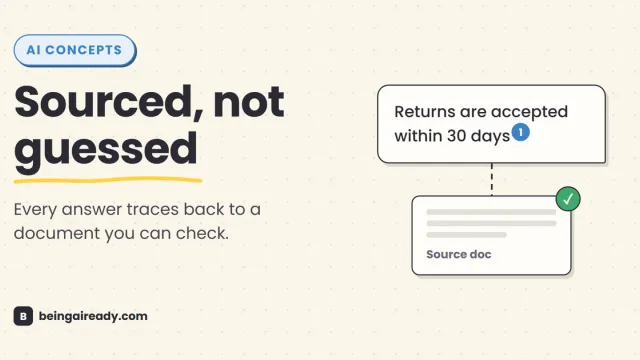
What Is RAG? Retrieval-Augmented Generation in Plain English
RAG is why some AI tools give a straight, sourced answer while others just guess with confidence. Here's what it is and how it works — without the jargon.