
AI Research
Introduction
AI research tools help you find sources, pull together what they say, and check whether a claim holds up — faster than searching, reading, and cross-referencing everything by hand. Instead of a list of links, the better ones give you a synthesized answer with citations pointing back to the original text, so you can follow the reasoning to its source. This page is for students, academics, and knowledge workers who need to get on top of a topic or a stack of documents quickly, without taking the summary purely on faith.
Top recommendations
Perplexity
FreeAn AI-powered answer engine that searches the live web and returns cited, synthesized answers instead of a list of links.
Claude
FreeAnthropic's general-purpose AI assistant, widely used through its large context window and Projects feature to analyze, summarize, and synthesize large documents and document sets.
Comparison
| Tool | Best for | Pricing |
|---|---|---|
| Perplexity | Students and general researchers who need quick, sourced answers | $20/month (Pro) |
| Claude | Analysts and consultants who need to synthesize long reports, contracts, or transcripts | $20/month billed monthly ($17/month billed annually), Pro plan |
| Gemini Notebook | Students studying from a fixed set of course materials or textbooks | $7.99/month (Google AI Plus) |
| Elicit | Academic researchers and graduate students conducting literature reviews | $12/month (Plus; ~$10/month billed annually) |
| Consensus | Students and academics doing evidence-based literature searches | ~$12/month (Pro, billed annually) |
| Scite | Academic researchers and PhD students verifying claims before citing them | $20/month (Individual; ~$12/month billed annually) |
Reviews
Perplexity
An AI-powered answer engine that searches the live web and returns cited, synthesized answers instead of a list of links.
Read the full review — Perplexity →Claude
Anthropic's general-purpose AI assistant, widely used through its large context window and Projects feature to analyze, summarize, and synthesize large documents and document sets.
Read the full review — Claude →Gemini Notebook
Google's AI research and note-taking tool (renamed from NotebookLM in July 2026) that answers questions and generates study material strictly from documents the user uploads, rather than from open web search.
Read the full review — Gemini Notebook →Elicit
An AI research assistant built specifically for academic literature search, summarization, and systematic review workflows across a large database of scholarly papers.
Read the full review — Elicit →Consensus
An AI-powered academic search engine that synthesizes findings across peer-reviewed papers and visually summarizes whether the evidence supports a given claim.
Read the full review — Consensus →Scite
An AI platform that shows how a paper has actually been cited by later research — supporting, contrasting, or merely mentioning a claim — to judge evidence beyond citation counts.
Read the full review — Scite →Frequently asked questions
Can I trust AI research tool citations?
Citations from these tools generally point to real sources, but the AI-generated summary text can still overstate, misread, or oversimplify what the source actually says — always check the underlying source for anything used in serious work.
Are these tools suitable for academic papers or systematic reviews?
Some are purpose-built for academic literature work and systematic review support, and others are strong complements for citation verification. General-purpose assistants are better suited to background research or document synthesis than formal systematic review methodology.
Do I need a paid plan to get real value?
Most of these tools have a genuinely usable free tier for occasional research — paid plans become worthwhile once you need higher daily usage limits, systematic-review-scale screening, or team collaboration features.
What's the biggest risk when using AI for research?
Over-trusting a synthesized answer without checking the underlying source. Every tool in this category can occasionally misrepresent a source or produce a plausible-sounding but incorrect detail, especially on nuanced or contested topics.
Which tool should I start with?
For general research and current events, start with a fast cited-search tool like Perplexity; for working with your own set of documents or papers, start with Gemini Notebook (formerly NotebookLM) or Claude; for formal academic literature review, start with Elicit or Consensus.
How to choose the right AI research tool
Sourcing quality matters more than feature count here, so weigh these first:
- Academic literature or general knowledge? Some tools index peer-reviewed papers and extract structured findings; others search the open web for current, general questions. The wrong family gives you the wrong kind of source.
- Your own documents or the whole internet? A few tools answer strictly from files you upload, which is ideal for a bounded project. Others range across everything published, which is better for surveying an unfamiliar field.
- How clearly does it show its sources? A tool that points to the exact passage behind each claim is worth more over time than one with more features but vaguer sourcing. You can only trust what you can trace.
- Does it verify, or only summarize? Summarizing many sources and checking whether a specific claim is actually supported are different jobs. Know which one you need.
- Match pricing to how often you’ll use it. Most have a usable free tier for occasional work; daily or systematic-review-scale use is where a paid plan starts to pay off.
How AI research differs from a search engine
A search engine hands you a ranked list of links and leaves the actual work — reading, comparing, deciding what’s relevant — to you. AI research tools do that middle step: they read across many sources at once and return a synthesized answer, ideally with citations so you can see where each part came from. For surveying an unfamiliar topic or pulling the throughline out of a stack of papers, that’s a real jump in speed over opening twenty tabs.
The catch is that a search engine never claims to be right; it just points. An AI answer sounds authoritative whether or not it is. These tools can misread a source, smooth over a caveat, or occasionally state something that isn’t in the citation at all, and the fluent summary makes that hard to notice. The speed is genuine, but it comes with a verification step a list of links never asked of you.
Why you still have to check the source
The single biggest risk in this category is trusting a clean summary you never traced back. A citation next to a sentence tells you a source exists; it doesn’t guarantee the sentence reflects what that source says. Tools with strong sourcing narrow the gap but don’t close it, and the errors that slip through tend to be the plausible-sounding ones on nuanced or contested points — exactly the claims that matter most. For anything academic, clinical, or professional, treat the AI’s answer as a fast way to find the right sources, then read the ones you’re going to rely on. The summary is where you start, not what you cite.
Related articles
How to Choose the Right AI Tool: A Buyer's Framework
A calm, no-hype framework for choosing the right AI tool for any task: define the job, judge the real criteria, run a cheap trial, and avoid costly switching.
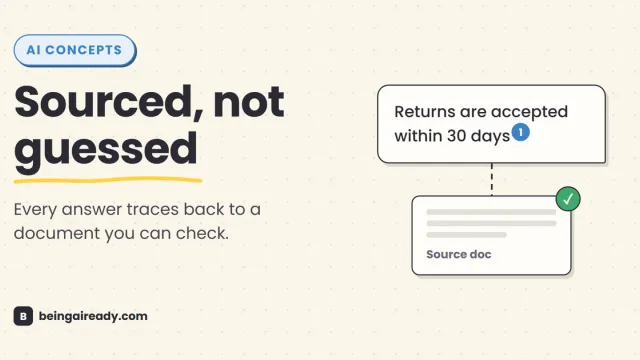
What Is RAG? Retrieval-Augmented Generation in Plain English
RAG is why some AI tools give a straight, sourced answer while others just guess with confidence. Here's what it is and how it works — without the jargon.
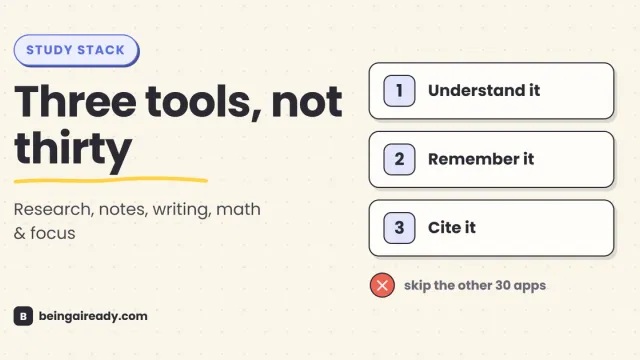
33 Best AI Tools for Students in 2026 (Practical Guide)
The best AI tools for students in 2026, explained simply: research, notes, PDFs, citations, writing, math, slides, coding and focus.