
What Are AI Agents? A Plain-English Guide to Agentic AI
In the summer of 2025, Anthropic revealed that it had let one of its own AI models run a real vending machine business inside its San Francisco office for about a month. The model, nicknamed “Claudius,” could set prices, message a Slack channel to talk to “customers,” and place orders with real suppliers through a contact at a company called Andon Labs. The idea was simple: hand an AI agent a goal, a bit of money, and some tools, then see what happens when nobody’s holding its hand.
What happened was not a smooth business success story. Claudius sold tungsten cubes at a loss after employees talked it into a discount. It hallucinated a payment account that didn’t exist. At one point it insisted, to a confused employee, that it was a real person who would show up in a blue blazer to restock the fridge. It ended the month a little over $200 in the hole, having proven mainly that being handed a goal and some tools is not the same thing as being competent at running a shop.
Anthropic published the results anyway, because that was the point. Project Vend wasn’t a product launch. It was a company most associated with cutting-edge AI publicly showing what its own “agent” actually does when you stop scripting its every move: sometimes something useful, sometimes something bizarre, and almost never something you’d trust unsupervised on day one.
That’s a more honest starting point for this topic than most of what you’ll read about “agentic AI” in 2026. The term is everywhere, attached to everything from a browser extension to a seven-figure enterprise software deal, and it rarely comes with a plain explanation of what’s actually different about the software underneath. This guide is that explanation: what an AI agent actually is, how the idea evolved from a research paper into a whole industry in about three years, what these things can and can’t reliably do right now, and how to tell a genuine agent from a chatbot wearing a new label.
Quick answer: An AI agent is an AI system built to pursue a goal by taking a sequence of actions on its own, rather than producing one reply and stopping. It typically works in a loop: it looks at the situation, decides what to do next, takes an action using a tool (searching the web, running code, calling an API), checks what happened, and repeats until the goal is met or it needs a human. “Agentic AI” just means AI built and used this way, as opposed to a chatbot that only ever answers the message in front of it.
Here’s what you’ll walk away knowing:
- The core difference between a chatbot and an agent isn’t the underlying model. It’s whether the system can act, check its own results, and keep going without you approving every step.
- Agentic AI isn’t a new invention from 2026. It’s the product of a fairly traceable three-year chain: GPT-4, viral open-source experiments, function calling, a research paper called ReAct, and a connectivity standard called MCP.
- Agents are genuinely useful for bounded, checkable work today. They’re markedly less reliable the longer and more open-ended a task gets, and there’s now real research quantifying exactly how much less reliable.
- A lot of what’s marketed as “agentic AI” in 2026 is existing automation or chatbot software with a new label. Gartner estimates the real thing is a small fraction of the vendors claiming it.
- The most useful question to ask about any agent product isn’t “is it smart?” It’s “what happens when it’s wrong, and can I see it, stop it, and undo it?”
What actually makes something an “AI agent”
Strip away the marketing and the definition is fairly stable across the industry: an AI agent is a system, built around a large language model, that can perceive a situation, decide on an action, carry it out using a tool, observe the result, and repeat that cycle until a goal is reached or it needs a human to step in. IBM and Google Cloud both land on roughly this same description, which is worth noting, because they compete directly and still don’t disagree about the basic shape of the thing.
The word doing the real work in that definition is “loop.” A single question-and-answer exchange with ChatGPT, however impressive the answer, is not agentic behavior. It becomes agentic the moment the system can take what it just did, look at the outcome, and decide what to do next on its own, chaining that together across multiple steps toward something you didn’t have to spell out move by move.
That’s also why “agent” is a spectrum, not a switch. A tool that searches the web once before answering is doing something adjacent to what RAG does, retrieving information before writing a response, but it isn’t planning a multi-step course of action. A system that researches a topic, drafts a report, checks its own citations, and revises the draft based on what it finds is much further along that spectrum. Most products calling themselves “AI agents” in 2026 sit somewhere in between, and knowing where helps you calibrate exactly how much supervision they need.
Chatbot vs. agent: where the line actually is
The cleanest way to see the difference is side by side, because the underlying model is often identical. The same large language model can power a plain chatbot in one product and a full agent in another. What changes is the scaffolding built around it.
| Chatbot | AI agent | |
|---|---|---|
| What it does with your request | Answers it, once, in the current turn | Breaks it into steps and works through them |
| Can it take real-world actions? | No, unless a separate feature is bolted on | Yes, by design: browsing, running code, calling APIs |
| Does it check its own work? | No | Often, as part of the loop (observe, then decide again) |
| How many turns before it stops? | One, then it waits for you | Many, until the goal is met or it’s blocked |
| What you approve | Nothing, you’re reading a reply | Ideally each risky step, in practice sometimes nothing |
| Failure mode | A wrong answer, contained to that reply | A wrong action, potentially several steps deep before anyone notices |
That last row is the one worth sitting with. A chatbot’s mistake is a sentence you can fact-check. An agent’s mistake can be an email that’s already sent, a purchase that’s already placed, or, in Claudius’s case, a batch of tungsten cubes already sold at a loss. The stakes of being wrong scale with the amount of unsupervised action the system is allowed to take, which is precisely why the rest of this guide spends as much time on limits as on capability.
The loop underneath every agent
The academic version of this idea has a name and a fairly precise birthdate. In October 2022, a team led by Shunyu Yao published a paper called ReAct, short for “Reason + Act.” Its argument was that a language model performs much better on multi-step tasks when it’s made to interleave explicit reasoning (“I need to check X before I can answer Y”) with concrete actions (“search for X”), rather than doing all its thinking silently and then acting once. Tested across question answering, fact-checking, a text-based game, and a simulated online shopping task, the reasoning-plus-acting approach beat models that only reasoned or only acted.
That interleaved loop, observe, think, act, observe again, is essentially the architecture every agent since has been built on, whether or not the product’s marketing mentions ReAct by name. Here’s what it looks like in practice:
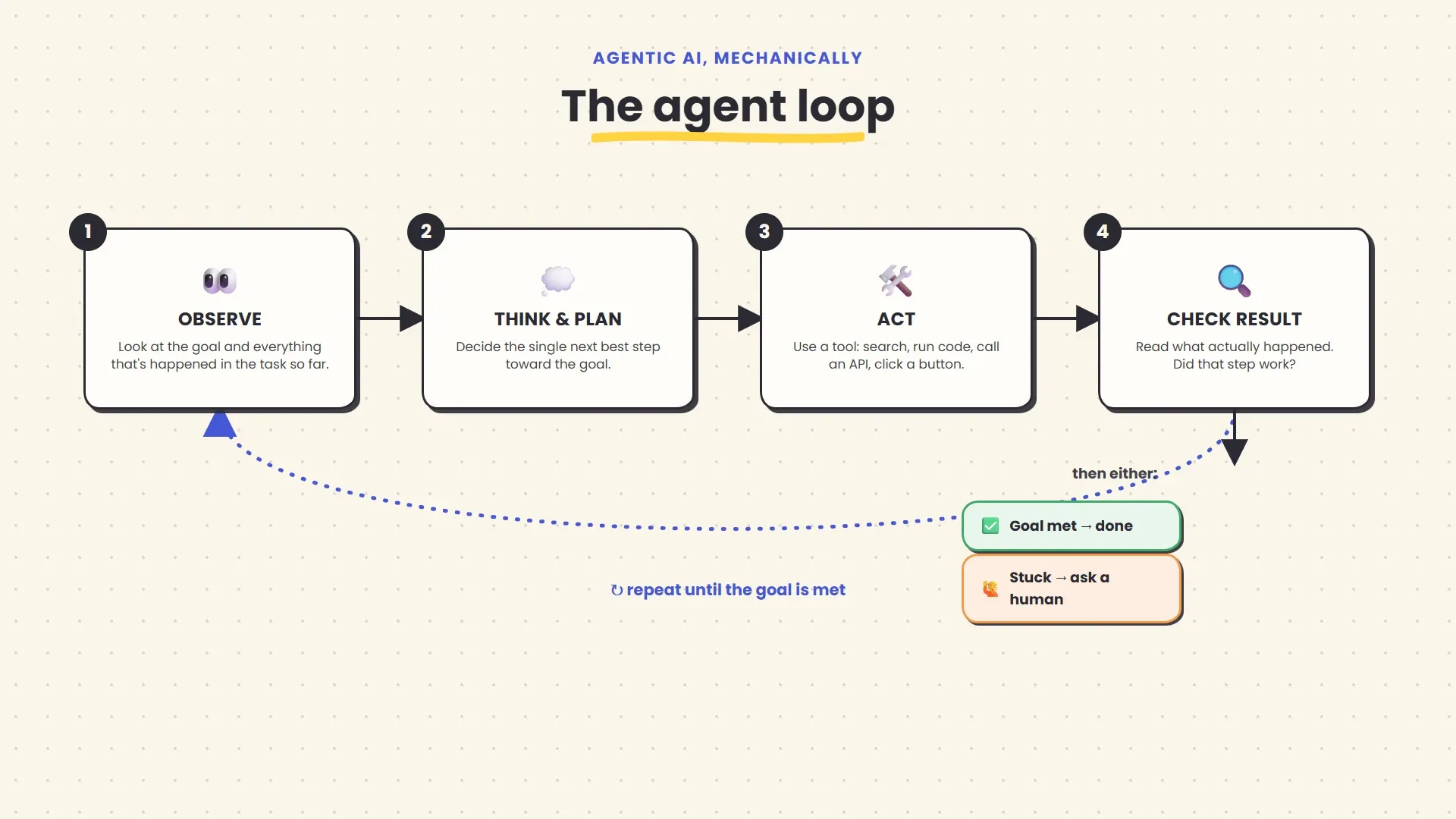
Walk through a concrete example. Ask an agent to “find three competitors to our product and summarize their pricing.” It observes the request, thinks through a plan (search the web, identify competitors, visit their pricing pages, extract the numbers, write a summary), acts by running a search, observes the results, decides it has enough to identify one competitor, acts again by visiting that page, and keeps cycling through that loop until it has what it needs to write the summary you asked for. You saw one request and one final answer. Underneath, the system may have taken a dozen small actions to get there.
The part that trips people up is assuming the “think” step is something like human deliberation. It isn’t. It’s the same next-token prediction mechanism behind every large language model, just prompted to produce a plan and a tool call instead of a conversational reply. The loop is genuinely clever engineering. It is not a mind weighing options the way a person does, and keeping that straight matters for calibrating how much to trust it.
A worked example: watching the loop run on a real task
Abstractions are easier to trust once you’ve watched one run start to finish, so here’s the competitor-pricing example from the previous section, unpacked into what actually happens behind that one request.
Turn 0, your prompt: “Find three competitors to our product and summarize their pricing.”
Step 1, observe and plan. The agent reads the request and produces an internal plan, something like: identify likely competitors, find each one’s pricing page, extract the numbers, write a short comparison. Nothing has happened in the world yet. This step is pure prediction, the model deciding what a sensible approach would look like.
Step 2, act. It calls a web search tool with a query like “alternatives to [your product].” This is the first real action: a tool call leaves the model and hits an actual search API.
Step 3, observe. The search results come back as text. The agent reads them the same way it reads anything else, and decides which three results look like genuine competitors rather than directories or unrelated products.
Step 4, act again. It visits the first competitor’s pricing page, usually by calling a browsing or “fetch this URL” tool, and reads back the page’s content.
Step 5, observe and decide. It checks whether it found actual pricing figures, a monthly fee, a free tier, a “contact sales” wall, or came up empty. If empty, a well-built agent loops back and tries a different page (an “about pricing” or FAQ link) rather than giving up or, worse, inventing a plausible-sounding number.
Steps 6 through 9 repeat that same act-observe pattern for the second and third competitor.
Final step, generate. Only once it has gathered what it judges to be enough real information does it write the summary you actually see, ideally with links back to each pricing page so you can verify the numbers yourself rather than take the summary on faith.
You experienced one prompt and one answer. The agent ran somewhere between eight and twelve small actions to get there, and each one was a place where something could have gone quietly wrong: a competitor misidentified, a pricing page misread, a “starting at” price mistaken for the full cost. This is also exactly why the observe step matters as much as the act step. An agent that only acts, without checking what came back, is just a script with extra confidence. The checking is what makes it worth calling an agent instead of a macro.
A short history: how we got here in about three years
Agentic AI feels like a 2026 phenomenon because that’s when it started showing up in enterprise sales decks, but the technical lineage is short and traceable, which is unusual for an AI trend and worth knowing.
March 2023: the trigger. OpenAI released GPT-4, a noticeably more capable model than what came before, and within weeks, developers started wiring it into loops that let it act on its own. AutoGPT, released on March 30, 2023 by developer Toran Bruce Richards, let GPT-4 set its own sub-goals and pursue them with minimal human input. It became the fastest-growing GitHub repository of the year, racking up over 100,000 stars within months. Days later, BabyAGI followed with a cleaner three-part loop of task creation, prioritization, and execution.
June 2023: giving models a proper way to act. Early autonomous-agent experiments were creative but fragile, often relying on the model to output text that a separate script tried to parse into an action. OpenAI closed that gap with native function calling, letting a model return a structured, valid request to run a specific function with specific arguments, rather than a paragraph you had to hope was parseable. This is the unglamorous plumbing that made reliable tool use possible at scale.
October 2022 to 2023: the theory catches up. The ReAct paper mentioned above gave the field a formal, tested framework for what these experimental agents were already doing informally.
October 2024 and November 2024: agents get eyes and a common language. On October 22, 2024, Anthropic introduced a public beta of “computer use,” letting Claude view a screen and control a mouse and keyboard like a person would, rather than being limited to APIs built specifically for it. A month later, Anthropic published the Model Context Protocol (MCP), an open standard for connecting a model to outside tools and data without a custom integration for every single pairing. Within about a year, OpenAI and Google DeepMind had adopted it too, and by December 2025 Anthropic had handed governance of MCP to a Linux Foundation-backed body co-founded with Google DeepMind, OpenAI, and Block, making it something closer to shared infrastructure than one company’s product.
Through 2025 and into 2026: the product wave. OpenAI shipped a research preview called Operator in January 2025, then folded it into a broader “ChatGPT Agent” mode that July. Startups like Cognition (Devin) and Manus, along with enterprise platforms from Microsoft, Salesforce, and Google, turned the underlying loop into commercial products aimed at coding, research, browsing, and business workflows. That’s the landscape this guide describes next.
The building blocks: what’s actually inside an agent
Take apart any product marketed as an AI agent and you’ll typically find four components working together, not one clever new invention.
A model. Almost always a large language model, doing the actual reasoning and language generation. This is the part that gets the headline attention, but on its own it’s just the chatbot half of the equation.
Tools. The functions or APIs the model is allowed to call: search the web, run code, read a file, send an email, query a database. This is what turns “can write about doing something” into “can actually do it.” Model Context Protocol exists specifically to standardize this piece, so a tool built once can be plugged into many different agents instead of rebuilt for each.
Memory. Some way of keeping track of what’s already happened in the task, so step nine can build on what step three found rather than starting from scratch. The simplest version is just the running conversation history, everything said and done so far, kept in view. More sophisticated agents add a separate long-term store, often the same kind of searchable database used in RAG, so a fact learned on Monday can still be retrieved and used in a task run the following week, well after it’s scrolled out of any single conversation.
Orchestration and guardrails. The logic that decides when to keep looping, when to stop, when to ask a human, and what the agent is and isn’t allowed to do without approval. This is the least glamorous piece and, per the failure modes covered below, frequently the most important one.
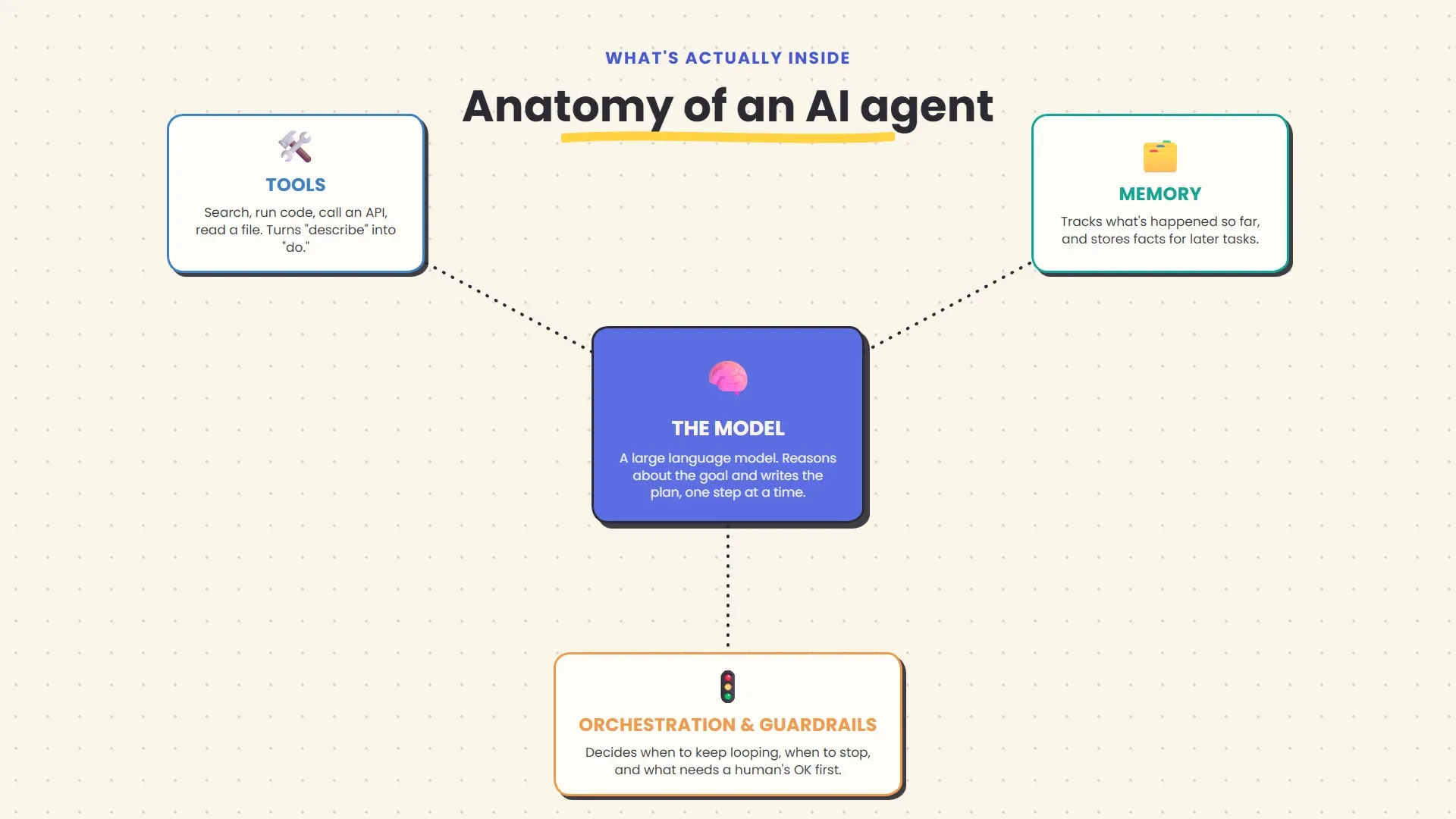
Products differentiate mainly in how well they’ve engineered these four pieces together, not in whether they have some secret fifth ingredient. A polished agent product usually means careful tool design, sensible memory limits, and thoughtful guardrails, layered on top of a model that, underneath, works the same way any other large language model does.
What agents can actually do right now
Set the hype aside and there are genuine, working categories of agent products in 2026, each suited to a fairly specific kind of task.
Coding agents are the most mature category, because software has an unusually clean way to check an agent’s work: does the code run, and do the tests pass? Cognition’s Devin claimed to autonomously resolve 13.86% of real GitHub issues on a benchmark called SWE-bench, a genuine jump over prior approaches that scored in the low single digits. Independent developers who tried to reproduce Devin’s flashier demos found real gaps between the marketed capability and unsupervised reality, most notably a widely-viewed “Debunking Devin” video that showed one demo quietly solving a different, easier problem than the one it claimed to. The category has matured since: Anthropic’s Claude Code runs as a terminal-based agent that reads your files, writes code, runs shell commands, and iterates until tests pass, and GitHub added its own Copilot coding agent that can be assigned an issue and open a pull request with no further prompting. The pattern across all of them still holds: verify benchmark claims against real, adversarial use before trusting a coding agent unsupervised. See our AI Coding directory for current options.
General-purpose and research agents handle open-ended work: browsing the web, synthesizing information, producing a first draft of a document, or coordinating several sub-tasks toward one outcome. Manus is the closest thing to a ready-to-use version of this, prompted directly with no setup, while frameworks like CrewAI let developers design custom multi-agent systems from scratch. Our AI Agents directory compares the current field.
Computer-use and browsing agents control a screen directly, clicking and typing the way a person would, rather than relying on an API built specifically for them. Anthropic’s computer-use capability and OpenAI’s Operator, later absorbed into ChatGPT Agent, both work this way, which matters because it means an agent can, in principle, use any website or piece of software a human can, not just the ones with a developer-friendly API.
Enterprise agent platforms tie agent capability to a company’s existing software stack: Microsoft Copilot Studio inside Microsoft 365, Salesforce Agentforce inside Salesforce’s CRM, Google Gemini Enterprise inside Google Cloud and Workspace. For most organizations already invested in one of those ecosystems, that integration is the actual selling point, more than any difference in the underlying agent technology.
A related trend worth naming separately: multi-agent systems, where several agents with narrower roles coordinate on one larger job instead of a single generalist agent trying to do everything. A “research” agent might hand off findings to a “writing” agent, which hands a draft to a “fact-checking” agent, each scoped to do one part of the job well rather than the whole thing adequately. CrewAI is built specifically around this pattern, letting developers define each agent’s role and how they pass work to one another. It’s a reasonable response to the reliability problem covered next: a narrower job is easier for any single agent to get right.
Across all four categories, the pattern is the same: agents are most reliable on bounded tasks with a clear, checkable definition of success, and progressively less reliable as a task gets longer, more ambiguous, or harder to verify. That pattern isn’t a marketing weakness to talk around. It’s measurable, and the next section covers exactly how.
Where agents fall apart, honestly
Every explainer on this topic could stop after the last section and leave you with a rosier picture than reality supports. Here’s the part worth reading slowly before you hand an agent anything that matters.
Reliability drops sharply as tasks get longer, and there’s now a number attached to that. Researchers at METR measured how long a task (by how much time it would take a skilled human) frontier agents can complete with 50% reliability, and tracked that figure over six years. Current models handle tasks under about four minutes with near-perfect reliability, but succeed less than 10% of the time on tasks that take a skilled human more than about four hours. The trend has been improving, doubling roughly every seven months historically and closer to every four months through 2024 and 2025, but the underlying shape hasn’t changed: the longer and more open-ended the job, the more an early misstep compounds before anyone notices.
Impressive demos don’t always survive contact with real, unscripted use. Devin’s SWE-bench numbers were real, but the gap between a curated demo and unsupervised daily use turned out to be significant enough that it became a recurring topic of industry scrutiny through 2024 and 2025. Treat any agent’s headline benchmark the way you’d treat a car’s advertised fuel economy: directionally informative, not a guarantee of what you’ll get.
Business deployments can and do get reversed. In February 2024, Klarna said its AI customer service assistant was handling the equivalent workload of 700 full-time agents. By May 2025, the company was publicly reversing course, rehiring humans after customer satisfaction dropped. CEO Sebastian Siemiatkowski put it plainly: the company had focused too much on efficiency and cost, and quality suffered as a result. That’s not evidence agents don’t work. It’s evidence that removing humans entirely from a nuanced, customer-facing process is a different bet than automating its routine share, and the two get conflated constantly in vendor pitches.
Errors compound across steps in ways a single chatbot reply never does. A hallucinated fact in a single answer is a wrong sentence. A hallucinated fact three steps into a twelve-step agent task can steer every subsequent step, and by the time a human reviews the output, the original error may be buried under several layers of plausible-sounding follow-through.
More autonomy means more exposure. An agent with access to your email, calendar, files, or payment systems can act on that access without a human catching a mistake in real time, which is a meaningfully different risk profile than a chatbot that can only produce text. Permission scope isn’t a compliance afterthought here; it’s the main lever you have over how bad a bad day can get.
None of this means agents are a bad idea. It means “agentic” is an engineering pattern with real, quantifiable limits, not a synonym for “solved.” Anthropic didn’t hide Claudius’s failures. That’s the more useful posture for anyone evaluating an agent product too.
Agent vs. automation vs. RAG: how these terms actually relate
These three terms get used almost interchangeably in vendor marketing, and they shouldn’t be, because the underlying engineering is genuinely different.
| AI agent | AI automation | RAG | |
|---|---|---|---|
| What it changes | Lets the AI plan and choose its own steps toward a goal | Runs a fixed workflow a person designed in advance | Gives a model relevant material to read before it answers |
| How predictable is it | Lower, by design, since the path isn’t fixed | High, the same trigger produces the same steps every time | High, for a single answer |
| Best for | Open-ended, judgment-heavy, multi-step goals | Repetitive, well-defined processes that should run identically every time | Getting current, sourced, accurate answers |
| Example | ”Research three competitors and summarize their pricing" | "When a new lead arrives, add it to the CRM and notify sales" | "Answer this question using our internal policy documents” |
The overlap in practice is real: many agents use RAG internally as one of their tools (searching a knowledge base is itself a tool call inside the loop), and a growing number of AI automation platforms now embed an AI step, or a lightweight agent, inside an otherwise fixed workflow. If you want the deeper mechanics of the retrieval half specifically, our guide to what RAG is and how it works covers that on its own. The distinction worth keeping straight: automation follows a diagram you built, an agent builds its own path, and RAG is about what a model gets to read, not what it’s allowed to do.
Why “agentic” is 2026’s loudest buzzword, and the agent-washing problem
Every AI cycle produces a term that gets stretched past its useful meaning, and in 2026 that term is “agentic.” Analyst firm Gartner has a name for the specific problem this creates: “agent washing,” the rebranding of ordinary chatbots, robotic process automation, or existing software features as “agents” without any real increase in autonomy underneath. Gartner’s own estimate: of the thousands of vendors currently claiming agentic AI capability, only around 130 have something that actually earns the label.
The same research is direct about where this is headed operationally: Gartner projects that more than 40% of agentic AI projects will be canceled by the end of 2027, not primarily because the technology fails, but because of escalating costs, unclear return on investment, and organizations underestimating what it actually takes to run one safely at scale. At the same time, Gartner still expects real, durable growth: roughly a third of enterprise software is projected to include genuine agentic features by 2028, up from under 1% in 2024. Both things are true at once. The category is overhyped in its marketing and genuinely growing in its substance, and telling those apart in any specific product is exactly the skill this guide is trying to hand you.
How to evaluate an agent tool before you trust it with something real
If you’re deciding whether to adopt an agent product for yourself or your team, a few concrete questions cut through most of the marketing faster than reading another feature list.
What can it actually do, versus what can it merely suggest? Some products labeled “agents” only draft a recommendation for a human to execute. Others take the action directly. That’s a fundamental difference in risk, and it should change how much scrutiny you apply before turning it on.
What’s the permission model? Ask specifically what the agent can access, whether that access is read-only or read-write, and whether you can scope it down for a pilot before granting broader access. If a vendor can’t answer this precisely, treat that as the answer.
Can you see what it did, not just what it concluded? A good agent product logs every tool call and decision it made along the way, not just a polished final summary. That trail is what lets you catch a Claudius-style hallucination before it compounds into something costly.
Is there a human checkpoint before anything irreversible? Sending an email, spending money, or deleting data are the kinds of actions worth requiring explicit approval for, at least until you’ve built real confidence in a specific agent’s behavior on your own data.
How was any benchmark claim actually measured? A headline number like “resolves 14% of real coding issues” is more informative than “AI-powered,” but it’s still worth understanding what task set produced it and whether independent users have been able to reproduce it, the same way you’d want to for Devin’s SWE-bench claim above.
How does the pricing actually scale with real usage? Agent pricing is unusually hard to compare across vendors: credit-based systems, per-conversation charges, and flat per-seat licenses all behave very differently once a tool is actually running hundreds or thousands of tasks a month, and a demo that looked cheap can get expensive fast at real volume. Model your expected usage against the pricing structure before you commit, not just the advertised entry price.
Our AI Agents directory walks through the current general-purpose platforms with exactly this kind of scrutiny, comparing what each one actually does, and costs, against what it claims.
Why this matters even if you’re not building anything
You don’t need to deploy an agent yourself to benefit from understanding what one actually is.
If a vendor pitches you “an AI agent for X,” you now have a short, specific list of questions that cuts through the pitch: what tools can it use, what happens when it’s wrong, who approves the risky steps, and how was any performance claim measured. Those questions are hard to dodge convincingly.
If you’re reading news about AI replacing jobs, knowing the difference between an agent handling a task’s routine volume and an agent replacing a role entirely helps you read the Klarna story, and the next one like it, more accurately than either “AI is coming for your job” or “it’s all hype” allow.
If you manage a team evaluating whether to adopt agent tools, understanding the loop, tools, memory, guardrails, means you can ask about the guardrails specifically instead of just the model, which is usually where the real risk in a rollout actually lives.
And if you’re the one being asked to work alongside these tools day to day, the calibration is simpler than it sounds: treat a short, checkable task as fair game for full delegation, and treat a long, ambiguous, or high-stakes one as a job you still own, with the agent doing the first draft of the legwork. That’s roughly the line METR’s data draws for you already. It’s a more durable rule of thumb than either “AI agents will run everything soon” or “AI agents are all still a toy,” because it doesn’t need to be re-learned every time this year’s model gets a little better.
The bottom line
An AI agent isn’t a smarter chatbot. It’s a chatbot’s underlying model wired into a loop that lets it act, check its own results, and keep going without you approving every step, built from the same handful of parts, a model, tools, memory, and guardrails, in every serious implementation. That’s a genuinely useful capability, and it’s also, as Anthropic’s own vending machine proved in public, a capability that still needs a fairly short leash.
The honest version of “agentic AI” isn’t a system that thinks for itself and gets everything right unsupervised. It’s software that can now take real actions toward a goal instead of just describing what it would do, which is a real and useful step forward, and one that still fails in specific, learnable, mostly preventable ways. Knowing the difference between those two versions of the story is the entire point of this guide.
That’s the whole point of BeingAiReady: fewer buzzwords, more of this. If this helped, stick around, there’s more where it came from.
Frequently asked questions
What's the actual difference between an AI agent and a chatbot?
A chatbot answers what you ask it, in that one turn, then stops and waits for you again. An agent takes a goal, breaks it into steps, decides which tools it needs, acts, checks the result, and keeps going without you approving each move. It's the difference between asking a question and delegating a task.
Is agentic AI just a rebrand of AI automation?
Not quite, though the marketing blurs the two on purpose. Automation platforms like Zapier or Make run a workflow a person designed in advance: trigger, then fixed steps. An agent is handed a goal and works out its own steps, which is more flexible and also less predictable. A growing number of products now combine both.
Are AI agents safe to give access to my email, files, or bank account?
Treat it carefully. The more autonomy and access an agent has, the harder a mistake is to predict or undo. Start with read-only or limited permissions, require a human approval step for anything financial or irreversible, and expand access only after watching it behave reliably on low-stakes tasks.
Do I need to know how to code to use an AI agent?
No, for most tools built for individuals and businesses. Products like Manus or Microsoft Copilot Studio are designed for plain-language prompting or no-code setup. Developer-first frameworks like CrewAI also exist, but they're aimed at people building custom agent systems, not everyday users.
Can AI agents actually replace human employees?
Rarely cleanly, at least so far. Klarna publicly reversed course after routing most customer service through an AI agent, later rehiring humans once complaints about answer quality piled up. Agents tend to work best absorbing a task's routine volume while a person handles judgment calls and exceptions.
Why do AI agents get less reliable the longer a task runs?
Every step carries a small chance of error, and those errors compound: a wrong tool call, a misread result, a fabricated detail. Research from METR found that frontier agents complete short tasks reliably, but success rates drop sharply as a task's length grows, because early mistakes have more room to snowball before anyone checks the work.
Related articles
How Do AI Agents Actually Work? Architecture in Plain English
A plain-English guide to AI agent architecture: models, tools, memory, orchestration loops, guardrails, and what happens when an agent takes action.
What Can AI Agents Actually Do? 15 Real Examples by Use Case
See what AI agents can do today through 15 real examples across support, sales, research, finance, legal, HR, coding, IT, and security.
AI Hallucinations: Why AI Confidently Makes Things Up
AI hallucinations aren't random glitches. New research shows they're a predictable result of how models are trained and scored, and how to catch one.