
AI Learning & Study Tools
Introduction
AI study tools give a learner patient, on-demand help with the actual work of studying — explaining a concept another way, generating practice questions from their own notes, or walking through a problem step by step instead of just handing over the answer. It's closer to always-available tutoring than to a search engine or a general chatbot. This page is for students, self-learners, and parents looking for practice and explanation between lessons, not for teacher-facing work like lesson planning or grading.
Top recommendations
Khanmigo
PaidKhan Academy's AI tutor and teaching assistant, built to guide students toward answers with Socratic-style questioning across Khan Academy's own curriculum, plus a free companion product for teachers.
Quizlet
FreeThe most widely used flashcard and study-set platform, now layered with AI features — Q-Chat tutoring, Magic Notes, and image-based flashcard generation — on top of its free core study tools.
Comparison
| Tool | Best for | Pricing |
|---|---|---|
| Khanmigo | Students roughly middle school through college who want a patient, always-available tutor across Khan Academy's math, science, and humanities content | $4/month or $44/year (Learner or Parent plan) |
| Quizlet | Students who already rely on flashcards and practice tests for memorization-heavy classes | $7.99/month or $35.99/year (Quizlet Plus) |
| Duolingo Max | Existing Duolingo users who want real conversational practice rather than just exercises | $29.99/month, or about $14/month ($168/year) billed annually |
| Photomath | Students who want to check their work or understand the steps behind a math answer, not just get the answer | $9.99/month or $69.99/year (Photomath Plus) |
| StudyFetch | Students who want a tutor grounded specifically in their own course materials rather than general knowledge | Around $7.99/month (Base plan) |
| Coursera Coach | Coursera Plus subscribers who want on-demand help understanding course material without leaving the platform | Included with Coursera Plus, $59/month or $399/year |
Reviews
Khanmigo
Khan Academy's AI tutor and teaching assistant, built to guide students toward answers with Socratic-style questioning across Khan Academy's own curriculum, plus a free companion product for teachers.
Read the full review — Khanmigo →Quizlet
The most widely used flashcard and study-set platform, now layered with AI features — Q-Chat tutoring, Magic Notes, and image-based flashcard generation — on top of its free core study tools.
Read the full review — Quizlet →Duolingo Max
Duolingo's premium AI tier, adding live conversational roleplay and an AI video-call partner on top of the standard Duolingo and Super Duolingo language-learning experience.
Read the full review — Duolingo Max →Photomath
A camera-based math solver, owned by Google, that scans handwritten or printed problems and returns step-by-step solutions and animated explanations rather than just a final answer.
Read the full review — Photomath →StudyFetch
An AI study platform built around Spark.E, a tutor that answers questions, builds study plans, and quizzes students using only the materials they upload — lecture recordings, slides, and handwritten notes.
Read the full review — StudyFetch →Coursera Coach
An AI learning assistant built into Coursera Plus that explains course concepts, quizzes learners with Socratic-style practice questions, and relates lessons to real-world professional scenarios.
Read the full review — Coursera Coach →Frequently asked questions
Will using these tools count as cheating?
It depends entirely on the assignment and the teacher's or institution's policy, not the tool. Tools built around Socratic questioning (Khanmigo, Quizlet's Q-Chat, Coursera Coach) are designed to guide a student toward understanding rather than hand over a finished answer, which is generally treated differently from a tool that just solves a problem outright, like Photomath's free step-by-step mode. When in doubt, ask before using any AI tool on graded work.
Can these tools replace a human tutor or teacher?
Not fully. They're genuinely useful for practice, explanation, and filling gaps between lessons, but none of them can assess a student's overall progress the way a teacher who knows that student can, and Khan Academy's own 2026 data — showing only around 15% of students with Khanmigo access use it regularly — is a reminder that access to a tool doesn't guarantee it gets used well.
Are any of these tools free?
Most have a free tier for basic functionality (Quizlet's core flashcards, StudyFetch's limited free plan, Duolingo's base app, Photomath's ad-supported solver), but the AI-specific features — tutoring chat, animated explanations, unlimited study-set generation — are almost always paid. Khanmigo is the exception for teachers, who get full access at no cost worldwide.
Is it safe to upload my notes, textbook photos, or lecture recordings to these tools?
Policies vary meaningfully. Khan Academy and Quizlet publish specific children's-privacy provisions (parental consent for under-13 accounts, no training on Khanmigo chat data). StudyFetch's privacy policy, by contrast, reportedly permits using uploaded content to train its AI models, with no explicit FERPA/COPPA statement found — worth reading before uploading anything sensitive.
What's the difference between this category and AI Research tools?
This category is about individual learners studying, practicing, and understanding material for a class or exam. AI Research tools like Perplexity, Elicit, Consensus, and Scite are built for a different job: finding and synthesizing academic or professional literature. A student writing a research paper might use both — a research tool to find and verify sources, and a study tool to practice and retain the underlying material.
How to choose the right AI study tool
The right tool depends almost entirely on the subject and the format you’re studying in, so start there rather than with a feature list:
- Match the subject. Broad multi-subject tutoring, memorization-heavy classes, spoken-language practice, and step-by-step math help are genuinely different problems, and the strongest tool for one is rarely the strongest for another.
- Decide whether it should use your own material. Some tools tutor from a fixed course library; others build flashcards, quizzes, and a chat tutor out of your specific notes, slides, or lecture recordings. If you’re studying for a particular class, the second kind usually fits better.
- Prefer tools that guide over tools that just answer. For learning that sticks — and for staying on the right side of academic-integrity rules — a tool that asks guiding questions beats one that hands over a finished solution.
- Check what’s actually free. Basic features are often free, but the AI parts — tutoring chat, unlimited practice generation, animated explanations — are usually paid. Budget for a small subscription rather than assuming full free access.
- Read the data policy before uploading. These tools are used heavily by minors, and vendors differ a lot on parental consent and whether they train on student content. Check before uploading notes, textbook photos, or recordings.
How an AI tutor differs from a textbook, a search engine, or a chatbot
A textbook explains a concept one way and can’t tell when you’re stuck. A search engine finds pages but leaves you to piece the answer together. A general chatbot will answer, but it’s built to be helpful, which often means just giving you the solution — the least useful thing for actually learning. A study tool is built for the opposite: it adapts the explanation to where you’re confused, generates practice at the right level, and — in the better ones — nudges you toward the answer with questions instead of supplying it. That last part is what turns passive reading into the kind of active practice that makes material stick, which is also why simply having access to an AI tutor isn’t the same as benefiting from one.
Studying with AI without crossing into cheating
The line isn’t the tool, it’s how you use it and what the assignment allows. Using an AI tutor to understand a concept, drill practice problems, or check your reasoning is studying. Having it produce work you then submit as your own is not, and no tool can make that call for you. Tools designed around guiding questions make the honest path easier, but even a straight answer-solver is fine for checking your work after you’ve attempted it yourself. When a class’s policy on AI isn’t clear, the safe move is to ask before using any of these on graded work — and to lean on them for practice and understanding rather than for producing the thing that gets graded.
Related articles
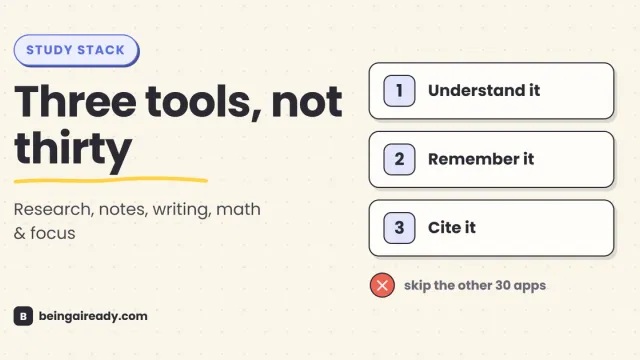
33 Best AI Tools for Students in 2026 (Practical Guide)
The best AI tools for students in 2026, explained simply: research, notes, PDFs, citations, writing, math, slides, coding and focus.
12 Best AI Tools for Teachers in 2026 (That Save Time)
A plain-English guide to the best AI tools for teachers in 2026: lesson planning, grading, quizzes, and admin. No jargon, just what works and where to start.
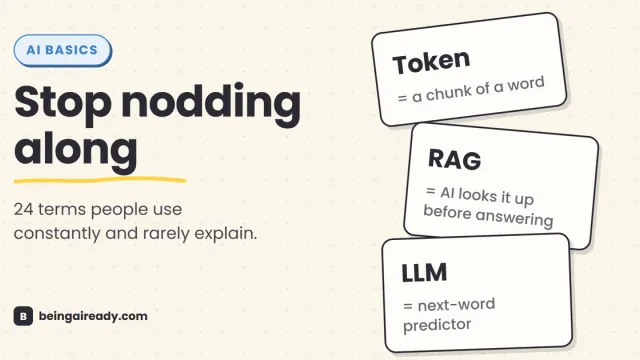
AI Terms Explained: A Plain-English Glossary of 24 Words
The 24 AI terms everyone uses but nobody defines — LLM, tokens, RAG, agents and more — explained in plain English, with analogies that actually stick.