
Elicit
An AI research assistant built specifically for academic literature search, summarization, and systematic review workflows across a large database of scholarly papers.
Visit website (opens in a new tab)Independent editorial listing. Features, pricing, and privacy terms can change; confirm details on the vendor site before buying or rolling out a tool.
What it does
Elicit is an AI research assistant purpose-built for academic work: it searches over 138 million papers using semantic matching rather than simple keyword search, summarizes and lets users “chat with” individual papers, and supports structured data extraction across many papers into a table. Its Systematic Review Workflow can screen thousands of candidate papers against inclusion criteria, making it particularly suited to formal literature reviews and meta-analyses rather than casual, one-off questions.
Ideal users
- Academic researchers and graduate students conducting literature reviews
- Teams running systematic reviews or meta-analyses
- R&D and evidence-synthesis teams in industry
- Anyone needing structured data extraction across many papers at once
Who should avoid it
- You need general web search or current-events information — Elicit isn't built for that
- You're a casual user with a single quick question — the tool is built for depth, not speed
- You need visual consensus scoring across studies — Consensus is more visual for that
Key features
- Semantic search across 138M+ academic papers and 545,000+ clinical trials via Semantic Scholar
- Chat with individual papers using full-text access
- Systematic Review Workflow that can screen thousands of papers
- Custom data-extraction table columns
- Personalized research alerts for new matching papers
- Export to CSV and BibTeX, with Zotero import
- API access for embedding Elicit's search and report generation into other tools
Pros / Cons
Pros
- Purpose-built for rigorous, structured literature review rather than casual search
- Genuinely usable free tier — unlimited search, summaries, and paper chat
- Strong data-extraction and export tooling for systematic reviews
- Large, academic-specific corpus rather than general web content
Cons
- Not designed for non-academic or general-knowledge questions
- Higher-tier plans are priced for serious or institutional use, not casual users
- AI-extracted data and summaries still require verification against the original paper
- Learning curve for the full systematic-review workflow compared to a simple search box
Pricing
Free — $12/month (Plus; ~$10/month billed annually)
Free (Basic) includes unlimited search, summaries, and paper chat but limited Research Agent usage; Pro ($49/month) adds a dedicated 5,000-paper screening workflow; Scale/Team ($169/month) adds figure extraction and real-time collaboration; Enterprise is custom-priced.
Typical workflows
- A researcher searches a review question, gets a ranked list of relevant papers with AI-generated summaries, then builds a table extracting specific data points across dozens of papers at once.
- For a formal systematic review, a team uses the Systematic Review Workflow to screen thousands of candidate papers against inclusion and exclusion criteria, then exports the final extraction table to CSV or BibTeX.
Integrations
- Zotero (import)
- CSV/BibTeX export
- API access
Privacy & security notes
Elicit's search and chat results link directly back to the source papers, so claims are generally traceable, but AI-generated summaries and extracted table data can still misstate what a paper actually found, so verification against the original text is recommended for anything used in a publication.
Frequently asked questions
How many papers does Elicit search?
Over 138 million academic papers plus 545,000+ clinical trials, via Semantic Scholar's index.
Can I use Elicit for a formal systematic review?
Yes — its Systematic Review Workflow can screen up to 5,000 papers on Pro (40,000 on Enterprise) against inclusion and exclusion criteria, with structured data extraction.
Is the free plan enough for a casual literature search?
Yes — Basic includes unlimited search, unlimited summaries, and unlimited paper chat; paid tiers add higher usage of the Research Agent, systematic review tools, and more table columns.
How accurate are Elicit's extracted data points?
Generally reliable but not perfect — extracted data should be spot-checked against the source paper before being used in a review or publication.
Best alternatives
Consensus
FreeAn AI-powered academic search engine that synthesizes findings across peer-reviewed papers and visually summarizes whether the evidence supports a given claim.
Scite
FreeAn AI platform that shows how a paper has actually been cited by later research — supporting, contrasting, or merely mentioning a claim — to judge evidence beyond citation counts.
Related tutorials
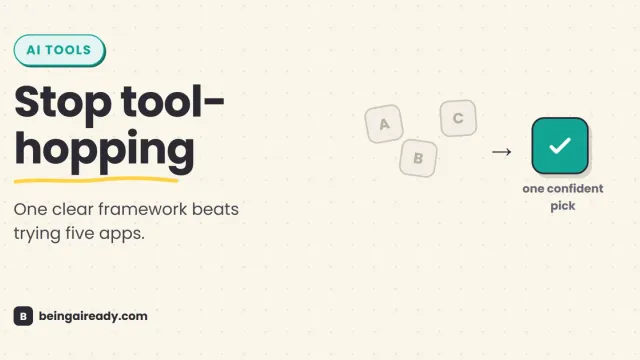
How to Choose the Right AI Tool: A Buyer's Framework
A calm, no-hype framework for choosing the right AI tool for any task: define the job, judge the real criteria, run a cheap trial, and avoid costly switching.
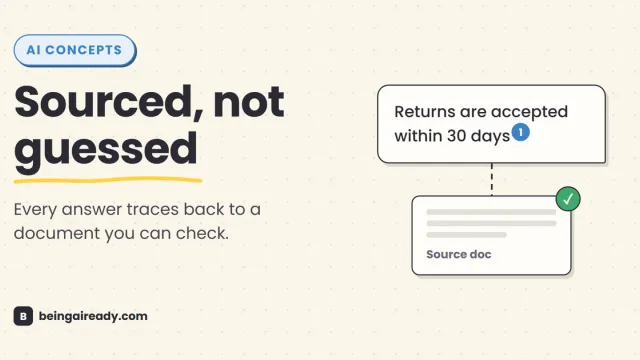
What Is RAG? Retrieval-Augmented Generation in Plain English
RAG is why some AI tools give a straight, sourced answer while others just guess with confidence. Here's what it is and how it works — without the jargon.
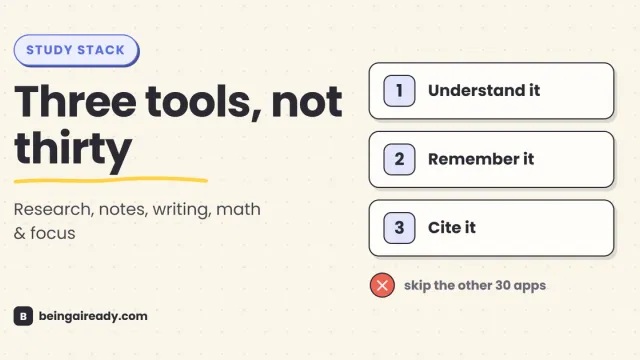
33 Best AI Tools for Students in 2026 (Practical Guide)
The best AI tools for students in 2026, explained simply: research, notes, PDFs, citations, writing, math, slides, coding and focus.