
Reflect
An AI-powered networked notes app built around backlinking and end-to-end encryption, designed for people who want a private, structured 'second brain' with calendar-aware daily notes.
Visit website (opens in a new tab)Independent editorial listing. Features, pricing, and privacy terms can change; confirm details on the vendor site before buying or rolling out a tool.
What it does
Reflect is a networked notes app built around backlinking — every note can link to others, forming a graph of connected ideas rather than a folder hierarchy. It layers AI on top of that structure: built-in voice transcription, writing assistance, and calendar integration that pulls each day’s meetings directly into a daily note. Its most distinctive feature is end-to-end encryption, which Reflect states prevents even its own team from reading user content — a stronger privacy stance than most hosted note-taking tools offer.
Reflect trades some flexibility for that focus: there’s no free ongoing plan, no folders, and no native Android app. It suits people who want Obsidian-style backlinked notes without managing plugins themselves, and who value the encryption guarantee enough to accept a smaller ecosystem.
Ideal users
- People who want a networked, backlinked note structure (similar to Obsidian) but prefer a polished, hosted app over a plugin-based local setup
- Privacy-conscious users who want end-to-end encrypted notes with AI features built in
- People whose notes are closely tied to their calendar — meetings, daily journaling, and recurring agendas
Who should avoid it
- You want a free ongoing plan — Reflect offers only a 14-day trial before requiring a paid subscription
- You're on Android — there's no native Android app, only browser access
- You want folders as a primary organizing structure — Reflect is built entirely around one flat, backlinked list of notes
- You need team-wide collaboration features — Reflect is built primarily for individual note-taking
Key features
- Networked notes with backlinking, forming a graph of connected ideas
- AI integration (built on models such as GPT-4 and Whisper) for writing help, summarization, and voice transcription
- End-to-end encryption, so Reflect states it cannot read your note content
- Google Calendar and Outlook integration for meeting-aware daily notes
- Web clipper for saving snippets from the browser and Kindle highlights
- Cross-platform sync, including offline access, across desktop and iOS
Pros / Cons
Pros
- End-to-end encryption is a genuine differentiator versus most cloud note apps
- Backlinking and a graph view give structure similar to Obsidian without needing to manage plugins
- Calendar integration ties notes directly to meetings and each day's agenda
- Voice transcription and AI writing help are built in rather than requiring separate plugins
Cons
- No free tier beyond a 14-day trial
- No native Android app
- No folders — everything lives in one flat, backlinked list, which can feel unstructured to some users
- Smaller ecosystem and fewer integrations than Notion or Obsidian
Pricing
Paid — $10/month (or $100/year)
No ongoing free plan is currently offered — only a 14-day free trial. Confirmed on reflect.app: pricing remains a single $10/month plan (billed annually, i.e. $100/year) covering all features, described by Reflect as 'one plan, one price'; no separate team or business plan exists.
Typical workflows
- Each day's note is automatically populated with that day's calendar events, so meeting notes and daily journaling happen in the same place, linked back to earlier related notes.
- Users record short voice notes that Reflect transcribes automatically, then link the resulting text into their broader note graph.
Integrations
- Google Calendar
- Outlook Calendar
- Web clipper (browser extension)
- Kindle highlights import
Privacy & security notes
Reflect uses end-to-end encryption and states that even Reflect's own team cannot read user note content. This is a meaningfully stronger privacy stance than most cloud note-taking tools, though users should still review Reflect's current documentation for exactly which features (such as AI processing) may require content to be decrypted server-side.
Frequently asked questions
Is Reflect really end-to-end encrypted, including the AI features?
Reflect advertises end-to-end encryption for note storage; check current documentation for exactly how AI features like transcription and writing suggestions interact with encrypted content, since AI processing may need decrypted access at the point of use.
Does Reflect have a free plan?
No — as of 2026, Reflect offers only a 14-day free trial, after which a paid subscription is required.
Can I use Reflect on Android?
Not natively — Android users are limited to browser access rather than a dedicated app.
How does Reflect compare to Obsidian?
Both use backlinked, networked notes, but Reflect is a polished hosted app with built-in encryption, calendar sync, and AI, while Obsidian is a local-first app whose AI features come from optional community plugins.
Best alternatives
Obsidian
FreeA local-first, markdown-based notes app where AI capabilities come entirely from optional community plugins like Smart Connections and Copilot for Obsidian, rather than a single built-in assistant.
Mem
FreeAn AI-native personal knowledge base that automatically organizes notes, meetings, and ideas, and lets you chat with your own notes to retrieve information instead of manually filing or searching for it.
Related tutorials
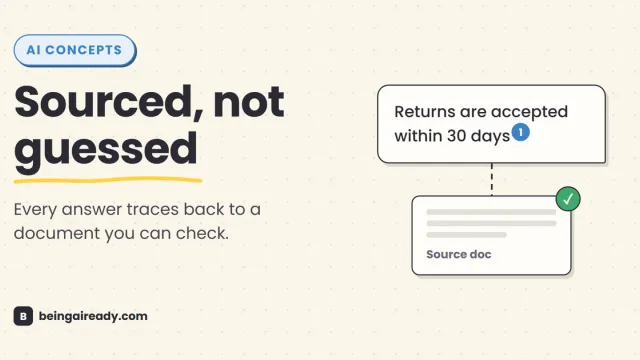
What Is RAG? Retrieval-Augmented Generation in Plain English
RAG is why some AI tools give a straight, sourced answer while others just guess with confidence. Here's what it is and how it works — without the jargon.
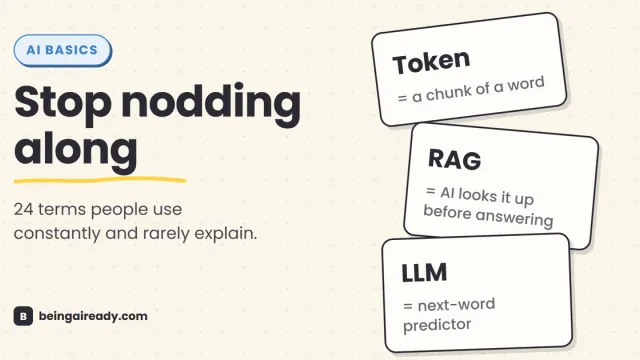
AI Terms Explained: A Plain-English Glossary of 24 Words
The 24 AI terms everyone uses but nobody defines — LLM, tokens, RAG, agents and more — explained in plain English, with analogies that actually stick.