
How to Use AI to Land a Job: A Practical 2026 Guide
There is a strange new symmetry to looking for a job in 2026. You sit down with an AI assistant to write your résumé, tailor your cover letter, and polish your applications. On the other side, a recruiter sits down with an AI system that parses, scores, and ranks those same applications before a human sees them. Two machines, negotiating on behalf of two exhausted people who would both rather be doing almost anything else.
Most advice about “using AI to get a job” quietly ignores that second machine, and the people who follow it end up doing the one thing that no longer works: producing more. More applications, faster, each one a little more generic than the last. The tools make it effortless, so people send hundreds. And then they wonder why the silence is louder than it’s ever been.
This guide is the honest version. Not “ten prompts to get hired,” and not a warning to avoid AI in your job search — that ship sailed, and avoiding it now just means competing with both hands tied. It’s a practical map of where AI genuinely gives you an edge in a job search, where it quietly works against you, and the specific difference between the two. The short version: AI is extraordinary leverage on the parts of a job search you’re bad at or slow at, and a reliable way to sabotage yourself the moment you use it to replace the parts that were always meant to be human.
Quick answer: AI helps your job search most when you use it as a thinking partner on a small number of well-targeted applications — decoding a job description, rewriting weak bullet points, and rehearsing interview answers. It hurts you when you use it as a volume machine to mass-produce generic applications, or as a crutch to fake competence you don’t have. The winning move in a market this crowded is not more applications. It’s fewer, sharper ones, plus far more preparation than most candidates bother with — and AI is very good at both of those.
Here’s what you’ll walk away knowing:
- Why the job market suddenly feels broken, and what the “AI versus AI” arms race means for how you should actually apply.
- The one mental model that separates useful AI help from the kind that gets you screened out.
- How to use AI to decode a job description, then build a résumé that survives the applicant tracking system and impresses the human behind it.
- How to write cover letters and profiles that don’t set off a recruiter’s AI radar.
- How to turn an AI assistant into a genuinely excellent interview coach — and the exact line, backed by law and by every recruiter surveyed, that you must not cross.
Why the job search suddenly feels broken
The job market didn’t get harder by accident, and it isn’t only that there are fewer openings. It’s that the cost of applying collapsed to almost nothing, so the number of applications exploded, and every part of the system downstream is now buckling under the weight.
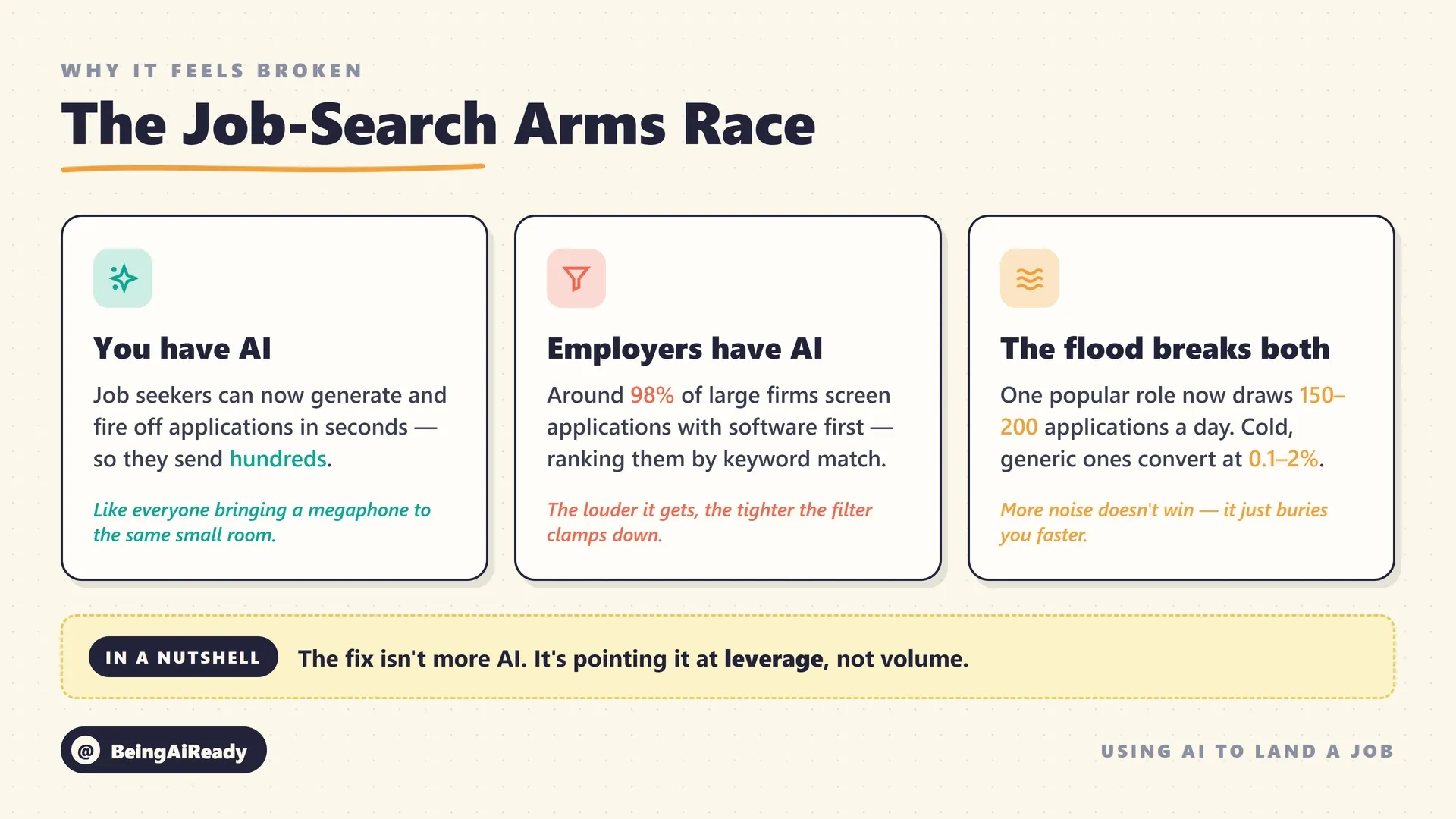
The numbers are genuinely startling. Job-search platform data reported by CNBC in late 2025 showed application volume on LinkedIn up more than 45% year over year, with thousands of applications submitted every minute across the platform. A popular posting now routinely draws 150 to 200 applications in its first 24 hours. One recruiter described the experience as “drinking through a fire hose.” At New York Life, recruiters reported receiving as many as 100,000 applications for roughly 1,400 open roles. The old ratio of a handful of decent résumés per opening is gone, and it isn’t coming back while applying stays this cheap.
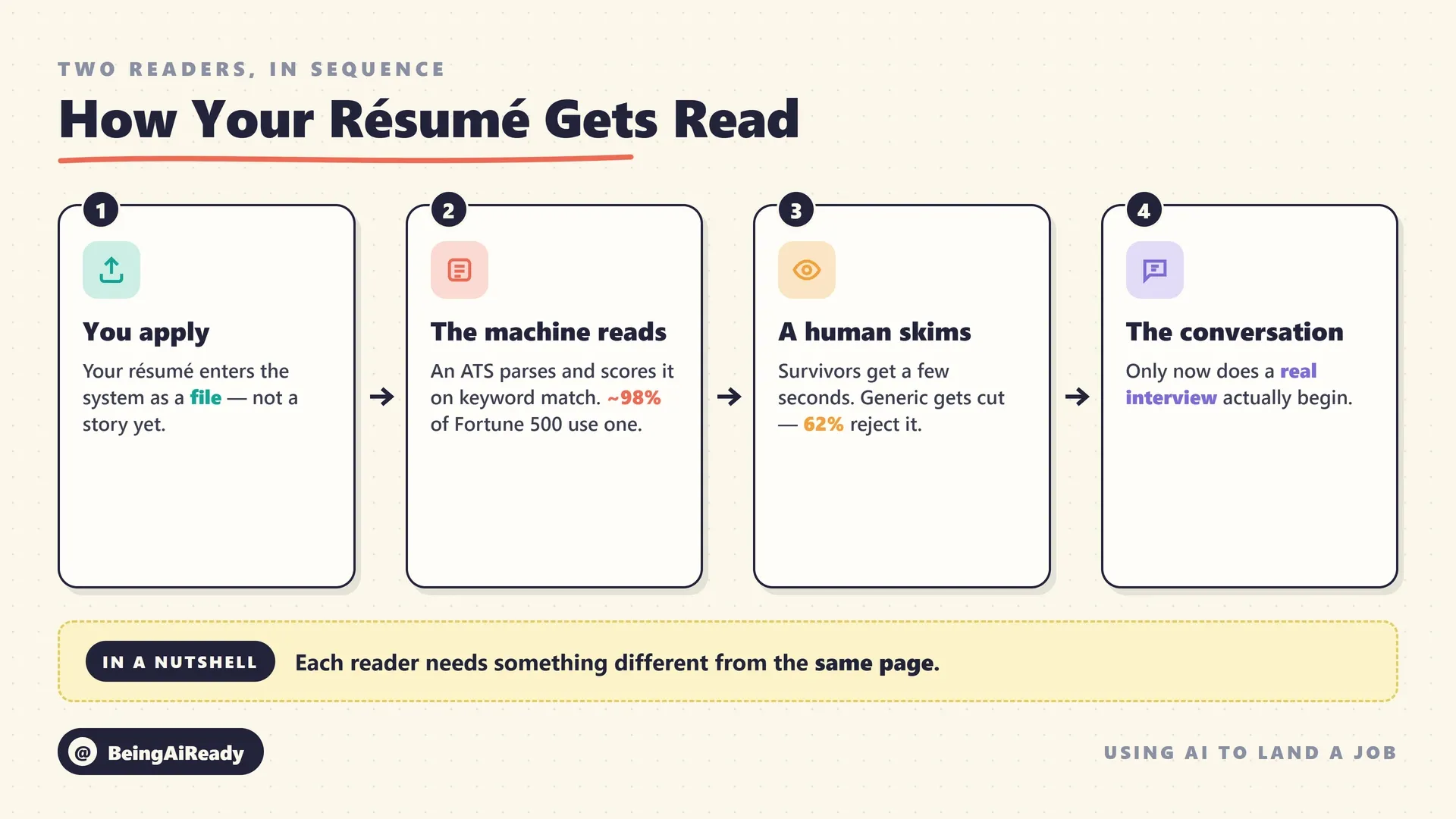
Employers responded the only way they could at that scale: with more automation. Around 98% of Fortune 500 companies now run an applicant tracking system — Jobscan’s 2025 analysis put it at 97.8%, or 489 of 500 — and the vast majority of employers now use some automated system to filter or rank incoming applications before a person reads them. That software isn’t reading your résumé the way a person would. It’s parsing it into fields and scoring how closely its language matches the job description.
So here’s the trap, and it’s worth naming plainly because so much AI-jobseeker advice walks people straight into it. AI made it trivial to apply to a hundred jobs in an afternoon. But cold, untargeted applications convert at something like 0.1% to 2% — meaning a hundred of them might yield a single reply, or none. Multiplying a strategy that barely works does not make it work; it just makes it faster to fail and burns you out doing it. The candidates who are struggling most right now are very often the ones using AI hardest, in exactly the wrong direction.
The way out isn’t to use less AI. It’s to point it at a completely different target: not volume, but leverage.
The one mental model: leverage, not automation
Before any specific tactic, internalise this, because it’s the thing that makes everything below work. The useful question is never “can AI do this part of my job search for me?” It’s “can AI make me dramatically better and faster at a part I’d be doing anyway?”
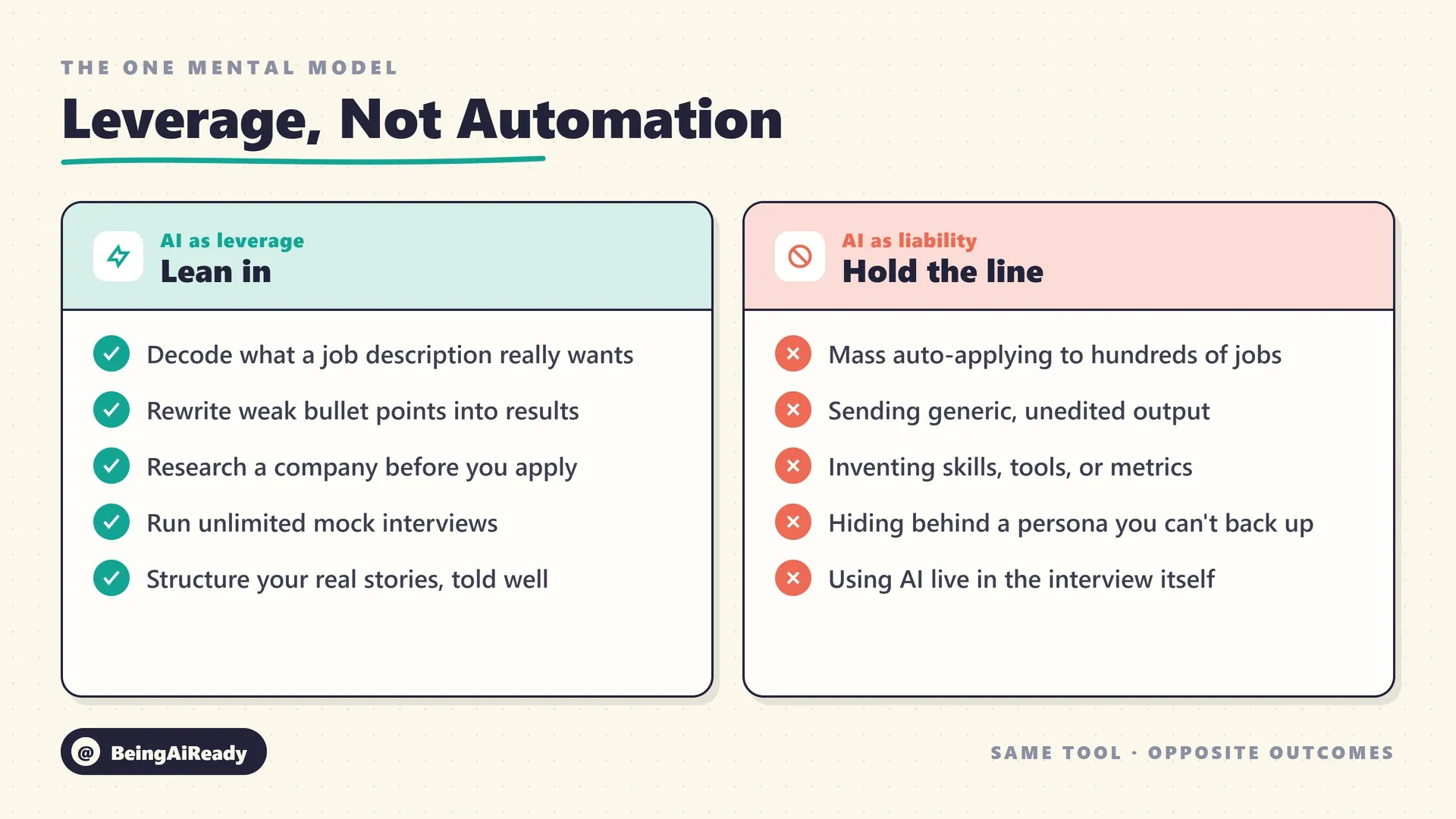
The distinction sounds subtle and is actually enormous. Using AI as leverage means you bring the raw material — your real experience, your genuine understanding of the role, your own judgment about fit — and AI helps you shape it faster and better than you could alone. Using AI as automation means handing over the whole task, including the parts that were the actual point, and hoping the output is good enough to pass. The first makes you a stronger candidate. The second makes you an interchangeable one, which in a flood of applications is the worst thing you can be.
A mental model that’s served people well across every AI-at-work task applies perfectly here: treat the assistant as a brilliant, tireless intern who is extremely capable but has never met you, has no memory of yesterday, and will confidently make things up when it doesn’t know something. You would never let that intern send an application under your name unsupervised. But you’d absolutely use them to turn your messy notes into a clean draft, to pressure-test your answers before an interview, or to research a company for an hour so you don’t have to. (If prompting an assistant well still feels like a mystery, our guide to prompt engineering for non-technical people covers the fundamentals, and our comparison of how to use ChatGPT, Claude, and Gemini well covers which assistant fits which task.)
Everything that follows is an application of that single idea. Where the leverage is high and the risk is low — decoding a role, rehearsing for an interview — lean in hard. Where the temptation is to automate away the human part — the personal detail, the live conversation, the honesty about what you can actually do — hold the line, because that’s exactly where it backfires.
Step 1: Use AI to understand the job before you touch your résumé
The single highest-leverage thing AI can do in a job search happens before you write a word of your résumé: helping you genuinely understand the job you’re applying to. Most rejected applications aren’t rejected because the candidate was unqualified. They’re rejected because the candidate never translated their experience into the specific language of the specific role — and that translation step is exactly what AI is best at.
Here’s why it matters so much. The applicant tracking system that reads your résumé first is, at its core, a matching engine: it scores how closely your document’s wording lines up with the job description. And the human who reads it next is running the same check in their head, just more forgivingly. The research on this is consistent and striking. Across large samples of applications, candidates who tailor each résumé to the specific posting report interview callback rates roughly two to three times higher than those sending one generic version everywhere. Same person, same experience — the difference is entirely in whether the application speaks the role’s own language back to it.
Doing that by hand for every application is slow and a little soul-destroying, which is why most people skip it. AI removes the friction. Paste a job description into ChatGPT, Claude, or Gemini and ask it to do the analysis you’d struggle to do objectively about yourself:
Here is a job description: [paste it].

Act as an experienced recruiter for this role. Tell me:
1. The 8–10 skills and keywords this employer most wants, in priority order.
2. The underlying problem they're actually hiring someone to solve.
3. The gaps I should expect to be probed on, given this description.

Be specific and skip anything generic that would apply to any job.
What comes back is a decoded version of the posting — the real priorities underneath the corporate phrasing, and the exact terms your résumé needs to feature if it’s going to match. This is the raw material for everything downstream. You’re not asking AI to write anything yet. You’re asking it to help you see the target clearly, which is the part most applicants get wrong before they’ve typed a single bullet point.
Do this even for jobs you think you understand. Roles that look identical from the outside — two “marketing manager” postings — often want quite different things underneath, and the gap between them is precisely where a tailored application pulls ahead of a generic one.
Step 2: Build a résumé that survives the ATS and impresses a human
Your résumé has to clear two very different readers in sequence, and most advice only accounts for one of them. First a machine parses and scores it. Then, if it survives, a human skims it in a few seconds. AI can help with both, but only if you understand what each reader is actually doing.
What the applicant tracking system actually does — and doesn’t
Start by deflating the myth, because fear of the “ATS robot” makes people do strange, counterproductive things. An applicant tracking system is mostly a database with a parser and a search function. When you upload a résumé, it tries to read your document and sort its contents into fields — name, work history, skills, education. Then recruiters search and filter that database, often by keyword, and the system ranks how well each résumé matches the posting. It is not a mysterious AI gatekeeper with opinions. It’s a filing system that struggles when a document is hard to file.
That reframing tells you exactly what to do, and it’s unglamorous. Use standard section headings the parser expects (“Experience,” “Skills,” “Education”), not clever ones. Avoid burying critical information inside tables, columns, text boxes, or graphics that parsers routinely mangle. Save as the format the posting asks for, usually a PDF or Word document, and keep a plain, clean version alongside any beautifully designed one — because heavily styled templates are the single most common reason a résumé gets parsed into gibberish. None of this is where AI shines; it’s just structural hygiene, and getting it wrong means the best content in the world never gets read.
Where AI does help is the matching layer. Dedicated résumé tools built for this — the ones in our AI résumé builders roundup — score your document against a specific job description and show you which important keywords you’re missing. Jobscan checks a résumé you already have against a posting; Rezi and Teal build the résumé and layer in that matching as you go. A general assistant can approximate this too — feed it your résumé and the job description and ask which of the role’s priority keywords are missing — but the purpose-built tools do it more reliably because it’s the one narrow thing they’re designed for.
Use AI to rewrite weak bullet points, not to invent strong ones
This is the part where AI genuinely earns its place, and also where the temptation to cross a line is strongest. Most people describe their own work badly. They write duties, not results — “responsible for managing the social media accounts” — when what a reader wants is a specific, quantified outcome. AI is excellent at that transformation, if you give it something real to transform.
The workflow that works: give the assistant the raw truth, then ask it to sharpen the phrasing.
Rewrite this résumé bullet to lead with the result and be specific and
concrete. Keep it strictly truthful — do not add numbers, tools, or claims
I didn't give you. If a metric would make it stronger, ask me for it rather
than inventing one.

Original: "Responsible for managing the company's social media accounts."
Context: I grew our Instagram from about 2,000 to 9,000 followers over a
year, and a campaign I ran drove roughly 15% of that quarter's online sales.
Notice the two instructions doing the heavy lifting: keep it truthful and ask me rather than invent. Without them, this is precisely the task where an AI assistant will helpfully fabricate — a metric, a tool you’ve never used, a responsibility you never had — because it’s built to produce plausible, confident text whether or not it’s true. That tendency is worth understanding in its own right; we cover the mechanics in why AI makes things up. On a résumé, a fabricated line isn’t a harmless embellishment. It’s a claim you will have to defend, live, to an interviewer whose entire job in that moment is to probe it — and the moment you can’t, the whole document becomes suspect.
Used honestly, though, this is transformative. You supply the true raw material, AI helps you say it in the sharp, results-first language that both the parser and the human reward, and you end up with a résumé that’s genuinely better and still entirely yours.
The personalization test that actually decides it
Once your résumé clears the machine, a person spends a handful of seconds on it, and this is where generic AI output goes to die. The data here is blunt: a Resume-Now survey found 62% of hiring managers are more likely to reject an AI-generated résumé that hasn’t been personalized to the role. Recruiters aren’t rejecting AI. They’re rejecting generic — and unedited AI output is generic by default, because it has no idea which of your experiences actually matter for this specific job.
So apply one test before anything goes out. Could this exact document have been sent to a different company for a different role without changing a word? If yes, you haven’t finished. A tailored résumé names the things this employer cares about, foregrounds the experience most relevant to this posting, and reflects the priorities you decoded back in Step 1. That’s the whole game: AI gets you a strong, fast draft; your judgment about what matters for this role is what makes it land. The judgment is the part you can’t outsource, and it’s also the part that takes ten minutes, not ten hours, once AI has done the drafting.
Step 3: Cover letters and profiles without the tells
Cover letters are where the AI-detection anxiety is loudest, and where the real rule is simplest: the problem was never that you used AI, it’s that a purely AI-written cover letter is almost always obviously about nothing.
A May 2025 TopResume survey of 600 hiring managers found that 33.5% believe they can spot an AI-written résumé in under twenty seconds, and roughly one in five would reject a candidate for leaning on AI too heavily. But the same survey found just over half consider AI perfectly acceptable for proofreading and drafting support. The line isn’t AI-or-not. It’s whether the finished piece contains a single specific, true thing that only someone who actually read the posting and knows their own experience could have written.
That points to a division of labour that works well. You provide the substance — why this company, which of your experiences maps to their actual need, a specific detail about their product or recent work that genuinely interests you. AI provides structure, flow, and a second pass for tone. A prompt like this keeps it in its lane:
Here's a job posting: [paste]. Here are three specific, true things: why
this company interests me [X], the experience most relevant to their need
[Y], and a concrete detail about their work I want to reference [Z].

Draft a short, plain cover letter built around these. No clichés, no "I am
writing to express my interest," no invented enthusiasm. Sound like a
competent human, not a template.
The “tells” recruiters react to are predictable once you know them: opening with “I am writing to express my interest in,” breathless enthusiasm with no specific object (“I am incredibly passionate about your innovative mission”), perfectly balanced but empty paragraphs, and the same phrasing every other applicant’s AI produced from the same posting. Strip those out, put one real specific thing in every paragraph, and read the whole thing aloud once. If it sounds like you talking, it’ll pass. If it sounds like a press release, it won’t.
The same logic extends to your LinkedIn profile and any application free-text fields. AI is a good editor for making your existing profile clearer and better organised. It’s a bad ghostwriter for inventing a professional persona you can’t back up in conversation. Edit with it; don’t hide behind it.
Step 4: Manage the application system without drowning in it
Applying to jobs is now partly a logistics problem, and this is a place AI-adjacent tools genuinely help — as long as you keep them pointed at organisation rather than volume.
The useful category here is the application tracker. Tools like Teal and dedicated job-search trackers let you save postings, keep tailored versions of your résumé against each one, log where you are with each application, and store the job description you decoded so you can prep for the interview later. This is real, low-risk leverage: it turns a chaotic search across a dozen browser tabs and a messy spreadsheet into something you can actually see and manage. In a market where you might run twenty or thirty live applications at once, that organisational layer is the difference between a search you control and one that controls you.
Then there’s the category to be genuinely wary of: the auto-apply bots that promise to fire your résumé at hundreds or thousands of postings automatically. It’s worth being direct here, because they’re heavily marketed to desperate job seekers and they mostly make things worse. They optimize for volume — the exact metric that stopped working, in the exact market that’s already choking on it. Remember the conversion math: cold, untargeted applications land somewhere around 0.1% to 2%, so automating them at scale mostly automates rejection while stripping out the tailoring that actually moves the needle. You are not the only person who bought that tool, and the flood it contributes to is precisely why every individual application now matters more, not less.
The uncomfortable but liberating truth is that quality beats volume by a wide margin now, which is genuinely good news for anyone willing to do the work. Twenty applications where you decoded the role, tailored the résumé, and wrote a specific cover letter will, in almost every case, out-perform three hundred automated ones — and take less total time once you account for the interviews the generic blast never generated. Use AI to make each of those twenty faster and sharper. Don’t use it to make three hundred worse ones.
Step 5: Interview prep — where AI is genuinely excellent
If there is one stage of the job search where AI is close to unambiguously great, and where almost nobody uses it enough, it’s interview preparation. The risk is low, the leverage is enormous, and the thing it provides — realistic, repeatable, judgment-free practice — is exactly what most candidates skip and then wish they hadn’t.
Turn any assistant into a tailored mock interviewer
The best interview practice tool is one you already have. A general assistant, given the right setup, will run a realistic mock interview tailored to the exact role — and unlike a friend doing you a favour, it never gets tired, never runs out of follow-ups, and doesn’t mind doing it eleven times.
You are the hiring manager for this role: [paste the job description].
Interview me one question at a time — behavioural and role-specific, in a
realistic order. Wait for each of my answers before asking the next. After
each answer, give me brief, honest feedback: what landed, what was vague,
and one sharper way to say it. Start with your first question.
The one-question-at-a-time instruction matters — it forces you to actually answer under a little pressure instead of reading a list. Do this out loud, not in your head. The gap between an answer that’s clear in your mind and one that’s clear coming out of your mouth is where interviews are quietly lost, and closing it is mostly a matter of reps. AI gives you unlimited reps.
Beyond straight mock interviews, a few uses pay off disproportionately:
- Company and role research. Ask AI to summarise a company’s business, recent news, likely priorities, and the questions a candidate for this role should be ready for. Verify anything specific before you repeat it — assistants get details wrong and confidently so, which is why fact-checking AI answers matters even here — but as a fast way to walk in informed rather than blank, it’s excellent.
- Building your stories. Behavioural interviews reward concrete stories told well, usually in the STAR shape — situation, task, action, result. Tell AI a rough version of a real experience and ask it to help you structure it into a tight ninety-second answer. The story must be true; the structuring is where AI helps.
- Pressure-testing your weak spots. Ask it to play a skeptical interviewer and probe the softest part of your background — the employment gap, the career change, the missing skill. Rehearsing the answer you dread, a few times, in private, is worth more than an hour of rehearsing the ones you’ve got down.
There are also dedicated mock-interview products that add speaking analytics, body-language feedback, and role-specific question banks. A note on those, because search results are stale: Google’s Interview Warmup, long the default free recommendation, was quietly retired in 2026 — if a guide still points you there, that’s a sign it hasn’t been updated. Plenty of alternatives exist, but for most people, a general assistant used well covers the essential 80% at no extra cost.
The line you do not cross: using AI live in the interview
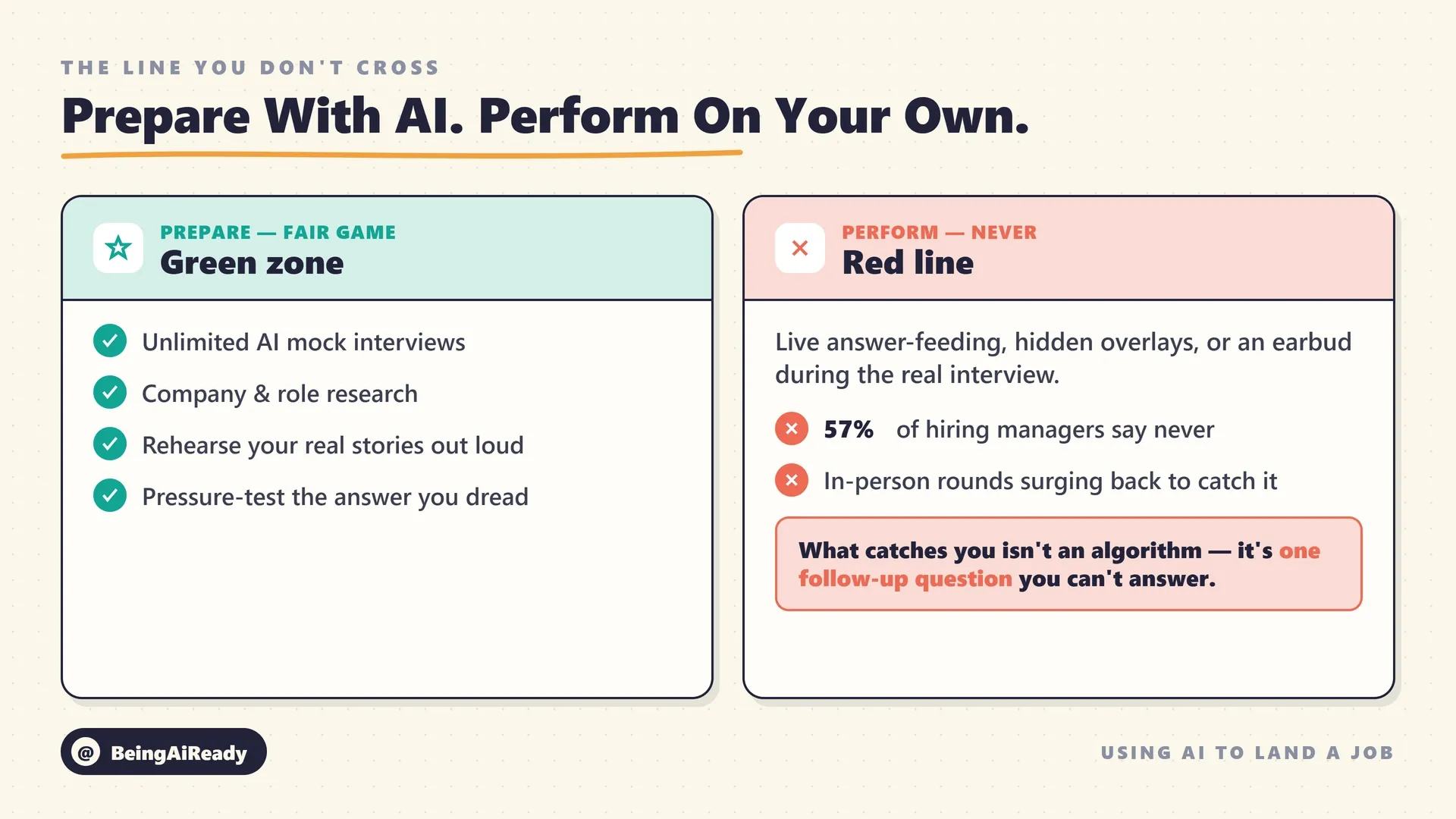
Here is where the whole “AI for jobs” story hits its hard boundary, and it deserves a section of its own because the temptation is real and the consequences are severe. Preparing with AI is smart. Using AI during a live interview — a hidden overlay feeding you answers, a second device, a voice in an earbud — is a different thing entirely, and it is the fastest-growing way people are torching their own candidacies right now.
The scale of it is remarkable. One analysis of more than 19,000 live technical interviews flagged 38.5% of candidates for AI-assisted cheating behaviour between mid-2025 and early 2026, a rate that had tripled in a matter of months. Employers noticed, and reacted hard. In-person interview rounds — which had nearly vanished — surged back, and companies including Google reintroduced in-person stages specifically to counter AI-assisted cheating. In the TopResume survey, 57% of hiring managers said real-time tools that feed you answers should never be used when speaking with an employer — the most one-sided result in the whole study.
Set aside the ethics for a moment and just look at the practicality, because that’s what most people underestimate. Using AI live doesn’t work very well even when you get away with the mechanics. It introduces a tell-tale lag, it produces answers that sound subtly not-like-you, and it collapses completely the instant an interviewer asks the one natural follow-up you can’t route through a chatbot in time: “interesting — can you walk me through how you actually did that?” The thing that catches live AI use is almost never a detection algorithm. It’s a human being asking a second question. And if you did fake your way in, you’ve won a job you can’t do, which is a slower and more painful version of the same rejection.
The rule is clean and worth committing to: prepare with AI as much as you possibly can; perform entirely on your own. Everything in the green zone above makes you a genuinely better candidate. The red zone makes you a fraudulent one, and the market has organised itself to catch exactly that.
What AI still can’t do for your job search
For all of the above, it’s worth being clear-eyed about the parts of a job search AI doesn’t touch — because they’re often the parts that actually decide it, and no amount of prompt-craft substitutes for them.
The biggest is human connection. The most reliable way to get hired has never been the front door of the application system; it’s a referral, a warm introduction, a conversation with someone already inside. Those routes work precisely because they bypass the automated filter this whole guide is about surviving — a point we make at length in how to break into a field without the traditional credentials. AI can help you prepare for a networking conversation, research the person, and draft a first outreach message. It cannot have the conversation for you, and it cannot build the trust that makes someone vouch for you. That’s still entirely human work, and in a flooded market it’s worth more than ever.
AI also can’t tell you whether a job is right for you. It can summarise a company and list pros and cons, but the judgment about whether a role fits your life, your values, and where you’re trying to go is yours alone — and it’s a judgment worth protecting from the general drift toward letting the machine decide. And of course AI can’t do the job once you have it. Everything you claim in an application is a promise you’ll have to keep on day one, which is the deepest reason the “use it as leverage, not a mask” rule holds: the version of you that shows up to work has to be real, so the version on the application had better be too. If you’re stepping into a role where you’ll be using these tools day to day, our guide to using AI at work without getting into trouble is the natural next read.
Putting it together: a saner weekly rhythm
The point of all this isn’t to add AI to a broken process. It’s to run a different process — fewer, sharper applications and far more preparation — that AI happens to make feasible for a normal person with limited time.
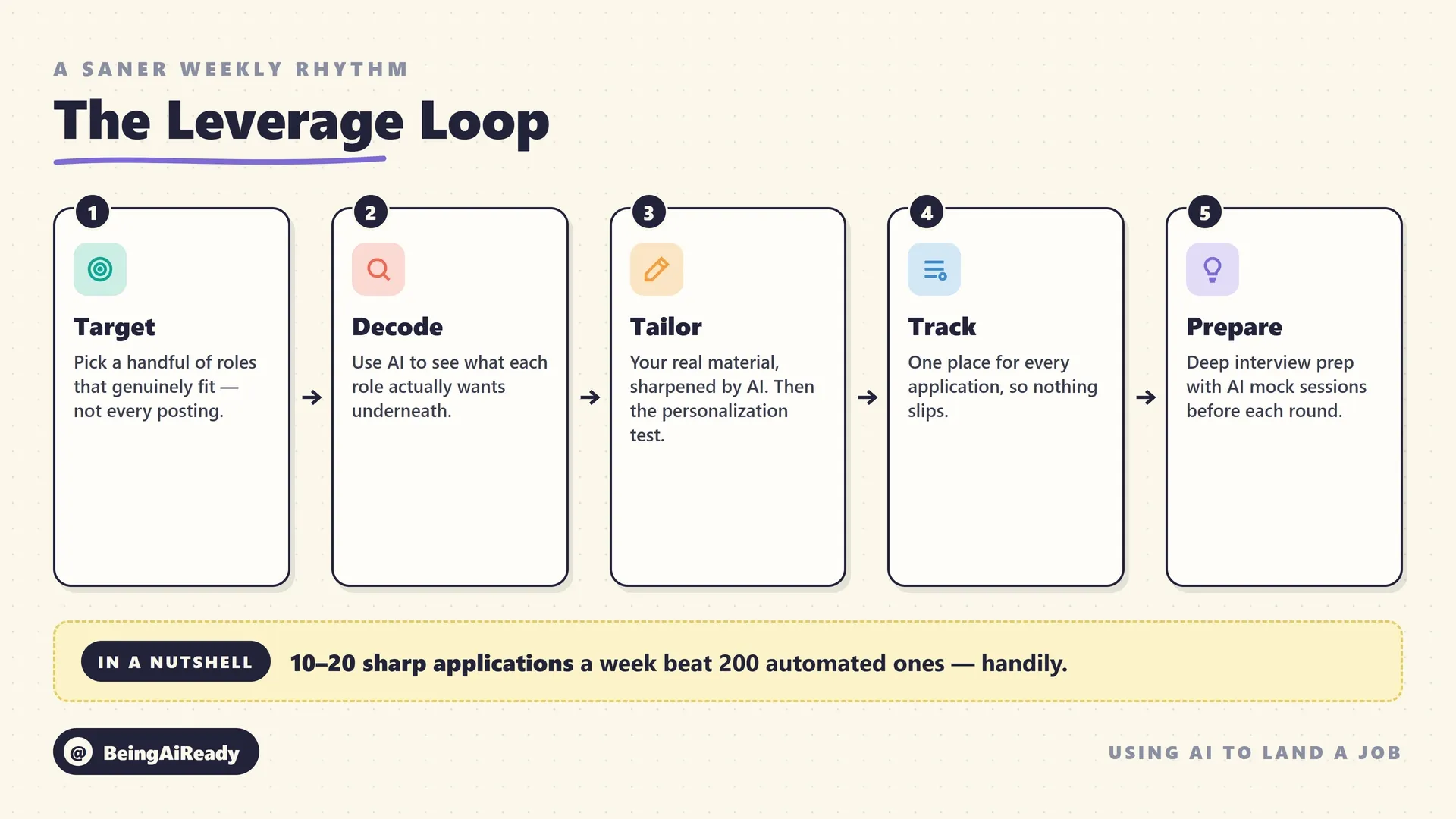
In practice that looks like a small, repeatable loop. Pick a handful of genuinely fitting roles rather than every posting you’re vaguely qualified for. Decode each one with AI so you understand what it actually wants. Tailor your résumé and a short cover letter to each, supplying the real material yourself and using AI to sharpen it — then apply the personalization test before it goes out. Track everything in one place so nothing slips. And spend real time preparing for the interviews you earn, using AI as the tireless mock interviewer most candidates never bother to use. Ten to twenty applications a week run this way will, in the current market, beat two hundred automated ones handily — and leave you far better prepared for the conversations that actually decide it.
The bottom line
The job market in 2026 is not rewarding the people who use AI the most. It’s rewarding the people who use it in the right direction — as leverage on their own real experience and judgment, not as a machine for manufacturing more generic applications into an already flooded system. Every genuinely effective move in this guide points the same way: fewer applications done far better, honest material sharpened rather than fabricated, and preparation deep enough that you don’t need a machine whispering in your ear when it counts.
That’s the quiet advantage available right now. While a large share of job seekers are using AI to apply faster and more thoughtlessly — and drowning in the resulting silence — the ones who use exactly the same tools to apply more thoughtfully stand out more sharply than they would have in any market of the last decade. The tools are the same. The direction you point them is the whole thing.
Frequently asked questions
Can employers tell if I used AI to write my résumé or cover letter?
Often, yes — or at least they think they can, which amounts to the same thing. In a May 2025 TopResume survey of 600 hiring managers, 33.5% said they could spot an AI-written résumé in under twenty seconds. What gives it away isn't the fact that AI was involved; it's generic, unedited output with no specific detail about the company or the role. A résumé you drafted with AI and then filled with real numbers, real projects, and language mirrored from the actual job posting reads as yours, because it is. The tell is genericness, not AI.
Will using AI to write my application get me rejected?
Not by itself. The same TopResume survey found that just over half of hiring managers consider AI acceptable for proofreading or drafting support, and only about one in five would reject a candidate outright for using it. What does get rejected is unpersonalized AI output: a separate Resume-Now survey found 62% of hiring managers are more likely to reject an AI-generated résumé that hasn't been customized to the role. Use AI to draft and refine, then make it specific. Using it to mass-produce identical applications is the version that backfires.
Is it cheating to use AI to prepare for an interview?
No — preparing with AI is one of its best and lowest-risk uses. Running mock interviews, researching the company, and rehearsing your stories with an AI assistant is no different in principle from practising with a friend. The line is live use during the actual interview. In the TopResume survey, 57% of hiring managers said real-time tools that feed you answers should never be used when speaking with an employer, and companies are increasingly returning to in-person rounds specifically to shut that down. Prepare with AI freely; perform on your own.
Should I use an AI tool that auto-applies to hundreds of jobs for me?
Generally no. Mass auto-apply tools optimize for the one number that no longer helps you — volume — in a market already drowning in it. Cold, untailored applications convert at roughly 0.1% to 2%, so blasting hundreds of them mostly generates rejections and burns your time. Tailored applications convert several times better. You'll almost always get more interviews from twenty carefully targeted applications than from three hundred automated ones, and you'll keep your sanity in the process.
What's the best AI tool for a job search?
There isn't a single best one, because the job search is several different tasks. A general assistant like ChatGPT, Claude, or Gemini handles most of the thinking work — decoding job descriptions, rewriting bullet points, running mock interviews. A dedicated résumé tool like Teal, Rezi, or Jobscan adds ATS scoring and keyword matching that general assistants don't do well. Most people are best served by one general assistant plus one résumé-specific tool, not a sprawling stack of ten.
Can AI actually get my résumé past the applicant tracking system?
AI can meaningfully improve your odds, but no tool can guarantee it. Roughly 98% of Fortune 500 companies use an applicant tracking system, and these tools mostly parse and rank résumés on how well their wording matches the job description. AI is genuinely good at surfacing the right keywords and flagging formatting that machines misread. What it can't do is invent experience you don't have, and it can't replace the human who reads your résumé the moment it clears the filter.
Related articles
How to Break Into AI Without a Degree: A No-Hype Roadmap
You don't need a CS degree to get hired in AI — you need proof. A month-by-month roadmap of the skills, projects, and job-search moves that get you hired.
AI Skills Every Professional Needs in 2026
Prompting isn't the AI skill that pays. Real labor-market data on what separates professionals who benefit from AI from those it quietly hollows out.