
Manus
A general-purpose autonomous AI agent that plans multi-step tasks from a single prompt, browsing the web, writing code, and delivering finished documents, slides, or small web apps.
Visit website (opens in a new tab)Independent editorial listing. Features, pricing, and privacy terms can change; confirm details on the vendor site before buying or rolling out a tool.
What it does
Manus is an autonomous AI agent built to take a single, often open-ended prompt and carry it through to a finished result rather than a conversation. Given a goal like researching a topic or producing a report, it plans its own steps, browses the live web, writes and runs code, and assembles the output — a document, a slide deck, a small deployed web app — largely on its own. It sits at the general-purpose end of the AI agent category: no CRM integration, workflow diagram, or coding framework to set up first, just a prompt and a credit-based usage meter that scales with how complex the task turns out to be.
Manus is also a useful case study in how quickly ownership can change in this market: its parent company, Butterfly Effect, was the subject of an announced $2 billion Meta acquisition in December 2025 that was blocked by Chinese regulators in April 2026. Meta completed an operational separation in June 2026, and a Tencent-led consortium (including original backers Sequoia China and ZhenFund) has agreed on a framework to buy back Meta’s stake — but as of mid-July 2026 that buyback is still being finalized, not complete. Treat any claim about who currently owns or operates Manus as something to re-verify before making a decision that depends on it.
Ideal users
- Individuals and small teams who want to hand off open-ended research, web, or file-creation tasks to an agent that plans its own steps
- People comfortable with a credit-based usage model rather than a flat monthly seat price
- Users who want one agent to browse the web, write code, and build slides or simple sites from a single prompt
- Non-developers who want agent capability without setting up a framework or wiring up integrations themselves
Who should avoid it
- You need enterprise governance, audit logging, or CRM-embedded agents — better served by Salesforce Agentforce or Microsoft Copilot Studio
- You want to build and orchestrate your own custom multi-agent systems in code — better served by CrewAI
- You need predictable flat-rate pricing rather than a credit system that scales with task complexity
- You need long-term vendor stability guarantees for a business-critical workflow, given the company's ownership churn in 2025-2026
Key features
- Plans and executes open-ended, multi-step tasks from a single natural-language prompt
- Live web browsing and a Browser Operator mode for interacting with sites and forms
- Writes and executes code, analyzes data, and produces finished files such as slides, spreadsheets, and reports
- Wide Research for running many parallel research subtasks at once
- Built-in Web App Builder for deploying simple sites or apps directly from a prompt
- Slack, WhatsApp, and Telegram integrations for triggering and receiving agent output
- Scheduled and concurrent tasks on paid plans
Pros / Cons
Pros
- Genuinely general-purpose — one agent handles research, coding, and file creation without separate setup per use case
- Low barrier to entry: a usable free tier and a paid tier starting around $20/month
- Delivers finished artifacts (slides, sites, reports) rather than just chat answers
- Fast iteration on new capabilities, with Wide Research, the Web App Builder, and messaging integrations all added within the past year
Cons
- Credit-based pricing makes real-world cost hard to predict — complex tasks consume credits quickly and unused monthly credits don't roll over
- 2025-2026 ownership instability (an announced Meta acquisition, blocked by Chinese regulators, then sold back to original investors) is a real caveat for anyone building a long-term workflow on it
- Not built for enterprise governance, compliance, or CRM-embedded use cases
- Autonomous browsing and task execution mean less predictable output than a rules-based workflow tool
Pricing
Free — $20/month (Standard plan, ~4,000 credits)
Confirmed 2026 individual tiers: Free (300 daily refresh credits, 5 concurrent tasks), Standard ($20/month, 4,000 monthly credits, 20 concurrent tasks), Customizable ($40/month, 8,000 monthly credits), and Extended ($200/month, 40,000 monthly credits); annual billing saves 17% across paid plans. Credit consumption scales with task complexity, and unused monthly credits expire. Team plan pricing is per-seat with a shared credit pool, SSO, and admin controls; see manus.im/pricing for current per-seat rates.
Typical workflows
- A user gives Manus a single prompt — for example, 'research competitor pricing in this market and build me a slide deck' — and the agent browses the web, gathers data, and delivers a finished slide deck without further step-by-step instruction.
- A team uses Wide Research to run many parallel research subtasks, such as checking a long list of companies against the same criteria, and receives a consolidated report.
- A non-developer uses the Web App Builder to describe a simple internal tool in plain language and gets a deployed, working web app back.
Integrations
- Slack
- Telegram
- Live web browsing / Browser Operator
Privacy & security notes
Manus states it does not process, disclose, or otherwise use personal information to develop, train, or refine any AI or machine learning model, and says it works to disable third-party training on user data; de-identified or aggregated data may still be used to improve the service. This stated policy has not changed through the 2025 Meta acquisition announcement or the 2026 reversal, per Manus's current help center documentation.
Frequently asked questions
Is Manus still owned by Meta?
Not currently, though the situation is still unwinding. Meta announced an agreement to acquire Manus's parent company, Butterfly Effect, in December 2025, but Chinese regulators blocked the deal in April 2026 on national-security grounds. Meta completed an operational separation from Manus in June 2026, cutting off data-sharing between the companies, and a Tencent-led consortium (including original backers Sequoia China and ZhenFund) has agreed on a framework to buy back Meta's stake at the original $2 billion valuation. As of mid-July 2026 that buyback was still being finalized rather than complete, so re-verify current ownership before relying on it for a business decision.
What does 'agent mode' actually do that a chatbot doesn't?
Instead of just replying with text, Manus plans a sequence of steps, browses the web, runs code, and produces a finished output — a document, deck, or small app — with limited further input from you.
Does Manus require technical skill to use?
No — it's designed for plain-language prompting, unlike code-first agent frameworks such as CrewAI.
How predictable is the cost?
Less predictable than a flat subscription. Manus uses a credit system where complex or long-running tasks consume more credits, so actual monthly cost depends heavily on how you use it.
Best alternatives
Relevance AI
FreeA no-code platform for building and coordinating teams of AI agents — an 'AI Workforce' — that handle business tasks like outreach, research, and support across thousands of integrations.
CrewAI
FreeAn open-source Python framework, plus a managed cloud platform, for building and orchestrating multi-agent AI systems where developers assign agents roles, tools, and tasks.
Related tutorials
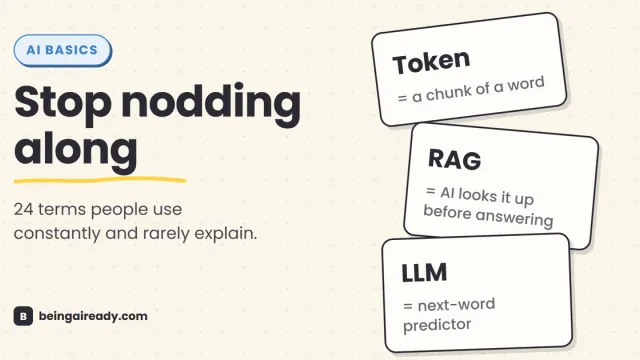
AI Terms Explained: A Plain-English Glossary of 24 Words
The 24 AI terms everyone uses but nobody defines — LLM, tokens, RAG, agents and more — explained in plain English, with analogies that actually stick.